Showing posts with label books. Show all posts

Monday, October 15, 2012

Splashes, Splashes

Five and a half years ago, Joy had a five-word-phrase in her repertoire for a brief span.  It was a line from Ring Around the Rosy:  "Ashes, ashes, all fall down!"

I went back to the archive of team-messages that I've been using for group communication for years, and there it was in the seventh message (we're up to #1551 by now):
I had to work very hard not to laugh the other day when she flung her cup, and then sang out her version of "Ashes, ashes, all fall down!"
I'd forgotten that incident, but remembered hearing the phrase on at least two additional occasions.  And then... Elvis left the building, the sliders on Joy's mixer board slid into a new position, and the phrase disappeared.

Fast forward to this weekend.

Joy came home from school on Friday with a new piece of artwork, this one containing both swirls and dots.   This one had been created to the tune of Ring Around the Rosy, a tune that Joy had suddenly begun to request that day.  We also learned that she'd been excited to work with LeapFrog phonics toys at school, which she'd connected with at home in a big way right around the end of 2011.  And the Brown Bear theme had continued at school as well, evidenced in a copy of Baby Bear, Baby Bear coming home with her for the weekend.

It rained most of the weekend.  Ordinarily this would be a bummer, but we've had a long string of parched weeks, so the rain was actually very welcome.  And guess who got to go out and make splashes and splashes, stomping in the puddles among the fallen leaves?


We played Ring Around the Rosy in the puddles, and Mama substituted a new line for the "ashes" line (that probably isn't a reference to the Black Death, though it's an oft-told myth):  Splashes, splashes, all fall down! Joy responded with many splashes and stomps and giggles, and helpfully refraining from actually falling down.

Then something seemed to catch her attention.  She looked, leaned to the side, took another looong look.

"Joy, what do you see?" asked Mama.

The response grew out of Brown Bear and our stomping-splashes, and just about took my breath away.
I see bird -- stomp, stomp, stomp!
Six words, gentle readers.  Six in a row, one more even than our long-lost Ring Around the Rosy line, in an original combination.

She was working other spoken-combos this weekend, too.  She says them slowly, with great emphasis, almost with a period after each word.

I. Want. iPad!

I. Want. Help!  

I. Want. Cracker!  

I. Want. Bread!  (This last was a request for the infamous zucchini bread)

I haven't heard a spoken request for a hug yet.  But you'd better believe she was receiving, this weekend.


And as for me, I am so greedy.

I. want. more.

But there were moments to be lived in, this weekend, and each one was a miracle unto itself.

Sunday, October 7, 2012

Brown Bear Banned

The below tidbit came my way from a college friend on Facebook, who'd seen my post on Joy's "Brown Bear" moment.  The "banned" image came with the accompanying text below:

In 2010, a member of the Texas State Board of Education called for the removal of "Brown Bear, Brown Bear, What Do You See?" by Bill Martin, Jr. from the state curriculum. Why? The board member said that Martin's works for adults contain “very strong critiques of capitalism and the American system." Fortunately, someone pointed out to this mistaken board member that Bill Martin, Jr. was not Bill Martin, a philosophy professor and author of "Ethical Marxism: The Categorical Imperative of Liberation." Oops.

JoyDad's response was swift:

Brown Bear, Brown Bear, what do you see?
I see a struggle between the proletariat and the bourgeoisie!

JoyTeachers, take note.  We depend on you to convey to our daughter, in suitable terms, the enduring significance of the RED bird!

Tuesday, July 3, 2012

You Can't Judge a Book By Its Cover

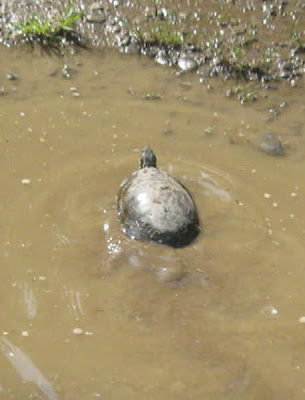
The unprepossessing back of a turtle escaping through a mud puddle

The spectacular undercarriage of that same turtle
Rose and I have read two excellent young-adult novels in recent weeks: Out of My Mind by Sharon Draper, and Wonder by R.J. Palacio.  (Some parts she read for herself, but mostly we did them as read-alouds). Both books feature 5th-grade student characters, a girl named Melody in Out of My Mind and a boy named Auggie in Wonder.  Rose will be a 5th-grader herself this fall!  Each 5th-grade protagonist has a strong family with two parents and a sister.  Each is intellectually ahead of the pack when it comes to their school peers.

And each has physical differences that shape how they interact with the world, and how the world reacts to them.

Out of My Mind was recommended to me via Partners in Policymaking.  Melody, who narrates in first person throughout the novel, has cerebral palsy.  She has a photographic memory, she's addicted to words, she can control an electric wheelchair, she can point and tap with her thumbs, but she can't walk or talk or feed herself -- so the world sees only the disability, and only Melody has access to the rich inner life of her own mind.  At least at first... When you put an electronic communication device at the disposal of a girl who knows how to read, you can expect that some amazing things will happen!

Melody's school experience, though, is just ugly.  She's been shunted off to a segregated "special-needs" room since she started school, and only in fifth grade is the school beginning to experiment with "inclusion" classes, where everyone (students and teachers both) completely underestimates Melody and her "special needs" classmates.

One aspect of Out of My Mind that hit me particularly hard was Melody as Cassandra-prophetess, when she sees something that's about to happen or in progress of happening that she needs to warn someone about -- and nobody can understand her or even get that they're supposed to be listening.

The story also brought back strong memories of my experiences on high-school quiz team.  (No further details about the novel forthcoming here; you'll have to read it to find out how this fits.)  My junior year, I was the only girl and the only junior on our high school's state championship Hi-Q team, a high-profile televised experience.  Our come-from-behind win in the last two minutes of the championship round was about the most exciting bit of my entire high school career.  It was fascinating to look back at my own experiences through the lens of Melody's adventures.

Rose was interested in Melody, and made a few tentative connections to Joy and her iPad.  But it was Auggie's story in Wonder that really grabbed her.  August Pullman gets to start prep school in grade 5 after a childhood of homeschooling through facial surgeries and medical fragility.  A stew of genetic irregularities has left him with a face to which people react with disgust and ridicule.  It makes for a challenging 5th grade year.  Fortunately Auggie, like Melody, is clever and has a strong sense of humor.

I think Rose was particularly captivated by Auggie's story for several reasons.  One, the author (a first-time novelist!) really captured the rhythm of middle-school dialog.  It sounded like people Rose knows.  She also appreciated the current pop-culture references (Diary of a Wimpy Kid!  Justin Bieber!)  She also liked that Wonder wasn't solely narrated by Auggie -- you also got to hear parts of the story told by other kids from Auggie's school, plus his big sister and a couple of her friends.  Oh yes, Auggie has a big sister!  So Rose got to hear big-sis Olivia describe the family as a solar-system where her brother is the sun and the rest of the family orbits him and his needs.  (To what extent is that us?)  She got to hear Olivia talk genetics and how she carries a gene for part of Auggie's condition that might affect her own child-bearing decisions... a new idea for Rose, and something we could assure her was not part of her situation.  But there were some genetic-science words introduced that have relevance to our story too, like "mosaicism."

I liked that neither story set up their 5th-grade protagonists as saints.  For the most part, they resisted the temptation to make everything too OK at the end.  And they both did a great job of weaving the end of the story with threads that had been introduced at the beginning.

I had to wonder, though -- I don't think that it's a coincidence that both characters were written to have above-average intelligence and were able to outshine their typical peers.  Melody could demonstrate (given the right technology) that she didn't belong in the "retard room" as her typically-developing classmates cruelly called it.  Auggie's academic performance could withstand the scrutiny of mean-spirited parents who didn't think a kid with a face like his could possibly be worthy of their precious (and deliberately non-inclusion) prep school.

Anyone got any good recommendations for novels with protagonists whose disabilities affect their intellect?

Meanwhile, on the drive home from the annual Memorial Day sojourn in the Upper Peninsula (whence cometh the turtle pics), Rose started to write a story based on herself and Joy, inspired by Wonder and Out of My Mind.  Maybe I'll be recommending her opus to you one of these days.

Friday, July 24, 2009

Storytime

If I tell you a story, will you tell me a story?

I've been nudged to think still more about the contents of my Library Conference post from a few days ago, after getting comments both from the moderator of the "Serving Students Along the Autism Spectrum" conference session, and from the creators of the "Libraries and Autism: We're Connected" training program and materials. An exchange of e-mails has followed, and some of my feedback has been incorporated into the Libraries and Autism web site -- plus Elvis Sightings seems to have become an Autism Blog of Interest, woohoo!

Anyway, this all led me to reflect on my own experience with Joy and the local public library. I'm hoping to hear some autism-related library stories from my readers too.

Joy is not an easy match with the public library. When Rose was little, I could take her to play with the books and toys, and she'd spend hours coloring or building with their huge toy blocks or perusing books with me. Joy doesn't work that way. She'd throw (or eat) the crayons, use the aisles as a racetrack, have little-to-no interest in the books I'd present.

In fact, it's even more challenging with books lately. Joy has always been hard on her board book collection, but the newest wrinkle is: she's decided that the best use for a board book is to fold it backwards, presumably for the sensory delight in breaking its spine. More and more of her books have ended up as tattered individual cardboard pages.

I don't check out library books for Joy to mangle.

Our most successful public-library experiences have come courtesy of a friend of ours who also happens to be the children's librarian at a nearby branch. Together with Joy's former daycare bud and his mom, we'd sign up for toddler story-times led by this librarian, for half-hour sessions full of songs, fingerplay, books and toys. I would have to do a lot of corralling Joy, and occasionally she'd be too intent on leaving to make it worth staying. The big bonus, though, was having the toddler-time led by someone who knew her and valued her, someone she was comfortable with, who didn't get bent out of shape when Joy was noisy or not particularly attentive or masticating her nametag or whatever.

Joy's full schedule of intensive autism therapy has pretty much ruled out any story-time attendance lately. I do take her to the library but it's mostly for my own errands, to check out books that I've placed on hold and to return others. She does enjoy helping me put each book into the return slot and pushing it until it falls, but I pretty much have to keep a tight hold on her hand the entire time we're there.

What public library memories do you have to share? (I said autism-related above, but if you have a non-spectrum story to share, sure, why not.) What works well at your public library in that regard? What doesn't? What would you change about it if you had your druthers? Tell me your story!

Saturday, May 9, 2009

What About Me?

Per usual, my reading list has been heavy on the fiction lately, and all from the library. I don't hear the siren-song of autism-book addiction quite the way some of my blog-friends do! Every once in a while, though, I do get seduced into picking up an autism-related book. And then I learn interesting things. And then I have to do a book report, 'cause I report out on everything else autism-related around here...

Anyway. The recent read was What About Me? Growing Up with a Developmentally Disabled Sibling, by Bryna Siegel and Stuart Silverstein. Siegel is a developmental psychologist (and imaginary BFF of Mama Mara) who has written a number of books on autism; Silverstein is a pediatrician and the older brother of a sibling with autism. So even though it's not directly billed as being about sibs with autism, that seems to be the jumping-off point.

So I found myself first gulping and eventually chuckling my way through the second chapter, about the research on sibs of developmentally disabled kids. I had no idea that we (and Rose) were so much behind the 8-ball. Consider:

  • Research suggests that having a handicapped sibling is consistently more difficult for older sisters (p.28)
  • Overall, girls tend to be more often negatively affected than boys (p.29)
  • Adjustment can be more difficult for same-sex sibs (p.30)
  • Sibs closer in age to the disabled sib tend to experience more distress (p.30)
  • It helps to have a larger family - more sibs to share the experience/load (p.31)

Add to that the research that families who planned their children carefully (me, plan? ME?) tend to feel a greater sense of unfairness when a child turns up with a disability, and that younger couples are often better able to cope than older couples (40-cough isn't OLD, is it?), and that authoritarian parents tend to have an easier time providing the sense of structure that a disabled child (especially with autism) may need... Well, we're just a mess waiting to happen, I guess. At least we're not single-parenting ("Without doubt, the most difficult situation to cope with is parenting a disabled child as a single parent") -- my hat is off to my blogfriends who ARE.

Except that, I actually think we're doing OK. So far anyway.

Rose seems like an exceptionally healthy kiddo.

I did pick up some interesting things to watch out for. The fundamental question, I think, is whether we're [un-necessarily] requiring things of Rose that we wouldn't require if Joy didn't have autism. We'll need to be careful about asking her to do too much Joy-care; right now it sometimes takes the form of "watch your sister for a minute while I go put the laundry in, OK?" Definitely something to keep to a minimum.

The other one I catch myself on is a little more insidious. It has to do with the fact that Joy is likely to do damage to Rose's stuff that gets left unattended in the open. So if Rose leaves a bunch of markers and her artwork all over the kitchen table and walks away, Joy is likely to grab the markers and crumple the paper. Should Rose have put the project away? Well, yeah. But most kids don't get such intense natural consequences for that kind of omission. We need to be sure we're sympathizing appropriately for all the wreckage, rather than solely reinforcing the lesson of, "Well, that's what happens when you leave your stuff where Joy can get it."

I also liked some of the general strategies that the book offered: Things like using humor to reframe sticky situations with Joy, giving Rose alone-time with parents, and being sure to give Rose her fair share of praise for accomplishments (seeing as how Joy gets such lavish praise for little things like putting on her own bib or saying even a single word).

The book also made an interesting comparison with the adult-children-of-alcoholics situation. The comparison has kind of an uncomfortable feeling about it, and as the authors point out, Twelve-Stepping obviously does not apply! but I did find myself nodding at a couple of the points. Both neurotypical sibs and COAs find themselves in situations of high responsibility, having to give up the right to be childlike at an early age, placing their own needs second, being unwilling to bring friends home to play, keeping a lot of bad feelings inside... very interesting.

Next up: Horizon (The Sharing Knife, Book 4) by Lois McMaster Bujold. Back to the fiction for me, friends!

Friday, April 24, 2009

Sisterly Generosity

Earlier this week Rose's school had one of those Scholastic Book Fair fundraiser things. I am a little ambivalent about how the kids come home with these carefully handwritten wish-lists that they've obviously done in class, but we've generally let Rose pick a book or two off her list to purchase, and chalked it up to community support.

The day of the book fair, Rose came charging home after school with a friend in tow. The friend had invited her to turn right around and go back to school with her mom for the book fair, and Rose really wanted to go NOW instead of have me take her later after Joy's therapy.

So I pulled out the lone twenty-dollar bill from my wallet, rehearsed with her which two books she wanted to buy, and got set to send her off.

And then she said, "Wait, I want to buy a board-book for Joy."

I didn't have any more money in the wallet, but before I could mention this, Rose had galloped off to her room and pulled out the box where she keeps her allowance. She counted out five dollars, which she was going to put in her bra-purse but I convinced her to take something that actually zipped up to keep the money safe!

Here's what she brought home for her sister:

Daisy's Rainbow Picnic

Between the change from the twenty and her allowance money, she'd had exactly enough with just a couple of pennies to spare.

Joy likes her new gift very much. She's been carrying it around a lot, and this evening I had to make her hand it over so I could get her to the table for supper. She said something that JoyDad, the barista and I all agreed sounded very much like "book."

=================

P.S. Just so it doesn't sound like we've got Saint Rose here or something... you should have seen the power struggle we had over clothing yesterday. It was COLD yesterday morning, and Rose wanted to wear capris and sandals to school. I made her wear long pants and shoes, which wrecked piano practice and the rest of the morning's preparation. After warning her that I didn't want ANY complaints about cold on the way to school, I let her get away with wearing a light hoodie for a wrap. Sure enough, about 5 minutes into the walk, the lower lip sticks out:

I didn't knooooow it would be so cold! It's NOT MY FAULT!

Natural consequences are a real booger sometimes. Heh.

Saturday, October 25, 2008

Joy! by Joyce Carol Thomas

This lovely board-book was given to us by friends in 2004 to celebrate the arrival of our younger daughter into our lives. It has nothing to do with autism in particular, but everything to do with... JOY.


Joy!
by Joyce Carol Thomas
pictures by Pamela Johnson

You are my joy
In every season
Summer, fall, winter, spring
You touch my heartstrings
You are my joy

You are my joy
Freed in the whipporwill's wing
Heard in the tall grass that sings
In the laughter that rings
From the sunny side of porches

You are my joy
Snug in a scarf and jacket
Rolling in leaves
Spun from autumn trees
In a yard lit by sunset

You are my joy
Lulled by the sound of
Icicle chimes
And water rhymes
Tap-dancing on sidewalks

You are my joy
Pointing at rainbows
Circling the earth
As it gives birth
To flowers

You are my joy
In every season
Summer, fall, winter, spring
You make my heart sing
You are my joy!

Tuesday, October 14, 2008

Maybe.

Cover image: Zen Shorts, by Jon J. MuthJoy & Rose's great-uncle & great-aunt gave them a lovely picture-book a while ago, a Caldecott-honor book by Jon J. Muth called Zen Shorts. The book tells several stories-within-a-story, short Zen meditations told in a manner appropriate for children.

Here's one of them:

There was once an old farmer who had worked his crops for many years.
One day, his horse ran away. Upon hearing the news, his neighbors came to visit.
"Such bad luck," they said sympathetically.
"Maybe," the farmer replied.

The next morning the horse returned, bringing with it two other wild horses.
"Such good luck!" the neighbors exclaimed.
"Maybe," replied the farmer.

The following day, his son tried to ride one of the untamed horses, was thrown off, and broke his leg. Again, the neighbors came to offer sympathy.
"Such bad luck," they said.
"Maybe," answered the farmer.

The day after that, military officials came to the village to draft young men into the army to fight in a war. Seeing that the son's leg was broken, they passed him by.
"Such good luck!" cried the neighbors.
"Maybe," said the farmer.

This story is good food for thought for me. I'm not a lot like this old farmer (garden produce notwithstanding). I tend to get dragged down by the "such bad luck" times and get mighty euphoric with the "such good luck" ones.

Here's one recent sequence of events and how it might look in some alternate-universe version of a JoyMama who's got the Zen thing going on:

Toward the end of last school year, JoyMama learned that Joy's speech therapist was going to take a different position in the school district, and wouldn't be available for Joy's team the next year, though ideally we'd have loved to see all three team members continue.
"Such bad luck," her loyal blog-land friends commiserated.
"Maybe," replied JoyMama.

Then we learned that the replacement would be a newer speech therapist with a lot of energy and good ideas. The new speech therapist coordinated efforts with the occupational therapist to bring projects to Joy's daycare in which all the daycare kids could participate. Not only is Joy taking well to the new strategy, but now is producing take-homes suitable for scrapbooking!
"Such good luck!" came the cheers in the comments.
"Maybe," replied JoyMama.

Then came word several weeks into the school year that the occupational therapist, who's been doing wonderful work with Joy and MADE several weighted vests for her, got reassigned to classroom-based work and would be leaving the team pronto. Now a totally unfamiliar OT would have to learn all about our complicated little sensory-seeker, all from scratch.
"Such bad luck," sympathized the readers.
"Maybe," replied JoyMama.

Then we learned that the new OT we've been assigned comes to the school district from Birth-to-Three (so she's experienced in working with early-childhood issues) and not only that -- she used to be the OT for one of the other kids at Joy's daycare, so she's already acquainted with Joy and Lynda and how the daycare is set up! I met with her this morning, got her signed up onto our team Yahoo group, she asked good questions and sounds enthusiastic.
"Such good luck!" exclaimed the bloggers.
"Maybe," replied JoyMama.

I guess we'll have to see what's next to come our way!