I'm glad to have a weekend going on here. Taking it very easy today, after a full and intense week.
At one point this morning, I plopped down onto the couch and flopped over onto the pillows, with a tired sigh.
JoyDad flopped next to me and hug-tackled me.
Joy, who'd been watching the TV at the other side of the room, circled around in our direction and twinkled at us. Much as if to say, "Gimme some of that hug-action!"
We laughed and called her to join us. She came right over, and scrambled up between us.
There we sat, a Joy-sandwich of a hug, and watched TV together for a while.
Just call it hug-therapy.

Showing posts with label therapy. Show all posts
Showing posts with label therapy. Show all posts
Saturday, March 27, 2010

Friday, April 17, 2009
Stacked


Bristle-blocks work best (they stay together better) and it helps to stack on an alligator-toy that makes noises when pressure is applied. Joy does not crack a smile as she stacks these things. She's doing it under a certain amount of protest.
But she's DOING it. With very little help.
P.S. Night-time sleep has been pretty good lately too. (Did I just jinx it?)
Saturday, February 21, 2009
Rules
So I had in mind to start this post with some cute collection of rules in our household, maybe some particularly quirky ones related to Joy's autism. But then I found a link from Quirky Mom to a most excellent post by One Sick Mother, who writes about Rules, Damn Rules, and Statistics. She structured the start of her post the way I'd hoped to do mine, only better than mine was coming out. So, go read hers, and remember her introduction. Then come back and finish mine.
One Sick Mother's well-deserved rant was about the rule-of-thumb kind of thing that physicians use in making their diagnoses, such as "Kids under the age of one don't tend to get strep." The problem comes when the rule becomes inflexible and exceptionless, morphing into "Kids under the age of one DON'T get strep." Her kiddo, of course, got to be Exhibit A of how the rule needed some flexibility.
I'm going torant about discuss rules that need flexibility too. We've had several examples lately of program rules that are designed to prevent various kinds of inappropriate behavior. Such rules (when not administered with flexibility) can have unfortunate consequences for people who behave WELL.
Here are the examples:
We have encountered different levels of flexibility with these three rules.
The administration we've encountered with Rule 1 is, in my opinion, a beautiful example of how flexibility should be employed. In my post about the baristas, I had written,
Our lead therapist read that and reassured me at our next meeting. She said she had no worries at all about barista-boundaries at our house, not even the informal data we've been collecting about who's got tattoos! (For the record, on our Agency 2 team there are 3 baristas with tattoos and one former Harley-rider. Which I think almost counts.) The rule, she explained, is there because not all families do have healthy boundaries, and sometimes parents will try to do things like glom on to a therapist as a Best Friend Forever or otherwise make unwelcome overtures. In which case -- it's very useful to have the rule to enforce.
Flexibility! The idea that not all families have to be punished because some families abuse privileges! Is that cool, or what?
So then we have the Project Lifesaver rule. I love the idea that the batteries and bands for the radio device don't need to be administered by the sheriff's department. It's been a hassle both for us and them to have us truck out to the station once a month or have them come to us to do the monthly battery replacement, plus it freaks out the neighbors to keep seeing squad cars in front of our home.
But. How silly is it that we have to burden someone ELSE with the battery storage and installation, and can't do it ourselves? We who can administer epilepsy meds three times per day for months, nay years, and never (OK, rarely) miss a dose?
Alas, there's no flexibility for the sheriff's department on this one. The rule comes down from Project Lifesaver Central and the deputies have to comply. So, we'll find a way to make it work. Our Wonder Woman daycare lady Lynda has agreed to get trained in how to do the monthly battery installation, and take delivery of the year's supply of batteries and bands. I'm sure we'll (wink) be able to work something out.
And then there's Rule 3. The biggie. The one from the state that says we have to have our House Blend therapy at home.
This rule was not always in place. At one point, therapy could happen at daycare as well as in the home. Lynda has experience with a previous kiddo at her daycare whose parents both worked full-time, and the child received oodles of House Blend hours at daycare. Which was great! Lynda's place is "therapy heaven," as one of our previous speech therapists put it. It's a home away from home, Lynda generally only has 6 kids at a time, she does a great job of participating in therapies and learning techniques and making suggestions and keeping everybody in the loop.
Unfortunately, there were apparently daycare situations that were not so ideal. Plus there came a budget crunch and a cutback in the number of hours that would be funded. Suddenly the pendulum swung crazily in the other direction. Therapy at daycare became suspect; therapy anywhere outside the home became suspect.
So, here's the ridiculous situation we find ourselves in. We have a glorious daycare setting, an ideal therapy setting, a home away from home. Joy's been going to this daycare for a couple of years, where she gets to be with peers and gets all the extra enrichment that Lynda's place offers.
If we'd had Joy at home alone with an au pair or a grandma or other one-on-one babysitter (anyone over the age of 18), the state wouldn't bat an eye at sending the therapists to that type of daycare setting. Which, in the case of a one-on-one paid provider, is generally more expensive than group daycare, which amounts to discrimination against working parents who don't have a lot of extra dollars to throw around.
But because we want her to have some therapy hours out of the home (four hours a week! only four, out of twenty-something!), we have to write these elaborate applications for three-month goals, with plans for how we're going to transition out at the end of those three months even if we're going to apply again. The most expensive member on our Agency 2 team (the lead therapist) is spending HOURS on these applications, plus daycare visits and documenting and generally going to bat for us.
Our first three months of therapy at daycare are winding up. The application for another round is in right now, though there have been several requests back from the state for further information and documentation. More administrative/clinician time and effort. For a lousy three more months, that might or might not be granted, and if granted, might be the last three months of House Blend therapy at daycare Joy gets to have.
Is this outrageous, or what?
Damn rules.
One Sick Mother's well-deserved rant was about the rule-of-thumb kind of thing that physicians use in making their diagnoses, such as "Kids under the age of one don't tend to get strep." The problem comes when the rule becomes inflexible and exceptionless, morphing into "Kids under the age of one DON'T get strep." Her kiddo, of course, got to be Exhibit A of how the rule needed some flexibility.
I'm going to
Here are the examples:
- From Agency 2: Parents and therapists must behave professionally toward each other at all times.
- From Project Lifesaver: A year's supply of batteries and bands for the Project Lifesaver radio-tracking device may be administered by someone other than the sheriff's department. However, that "someone" may not be the caregiver of the person wearing the band.
- From the state: Intensive autism therapy hours must happen in the home with an adult present in addition to the therapist. Preferably that adult should be a parent but really any adult over the age of 18 will do. Any therapy hours in other community settings must be applied for in advance, with detailed goals, and approval will only be for 3 months (at a time). You can't do more community hours than 25% of the therapy hours you have scheduled in the home.
We have encountered different levels of flexibility with these three rules.
The administration we've encountered with Rule 1 is, in my opinion, a beautiful example of how flexibility should be employed. In my post about the baristas, I had written,
I enjoy getting acquainted with our team members. Despite the official warnings in the paperwork about professional boundaries, I find that we share nuggets of our lives in conversation just because we do spend so much time together.
Our lead therapist read that and reassured me at our next meeting. She said she had no worries at all about barista-boundaries at our house, not even the informal data we've been collecting about who's got tattoos! (For the record, on our Agency 2 team there are 3 baristas with tattoos and one former Harley-rider. Which I think almost counts.) The rule, she explained, is there because not all families do have healthy boundaries, and sometimes parents will try to do things like glom on to a therapist as a Best Friend Forever or otherwise make unwelcome overtures. In which case -- it's very useful to have the rule to enforce.
Flexibility! The idea that not all families have to be punished because some families abuse privileges! Is that cool, or what?
So then we have the Project Lifesaver rule. I love the idea that the batteries and bands for the radio device don't need to be administered by the sheriff's department. It's been a hassle both for us and them to have us truck out to the station once a month or have them come to us to do the monthly battery replacement, plus it freaks out the neighbors to keep seeing squad cars in front of our home.
But. How silly is it that we have to burden someone ELSE with the battery storage and installation, and can't do it ourselves? We who can administer epilepsy meds three times per day for months, nay years, and never (OK, rarely) miss a dose?
Alas, there's no flexibility for the sheriff's department on this one. The rule comes down from Project Lifesaver Central and the deputies have to comply. So, we'll find a way to make it work. Our Wonder Woman daycare lady Lynda has agreed to get trained in how to do the monthly battery installation, and take delivery of the year's supply of batteries and bands. I'm sure we'll (wink) be able to work something out.
And then there's Rule 3. The biggie. The one from the state that says we have to have our House Blend therapy at home.
This rule was not always in place. At one point, therapy could happen at daycare as well as in the home. Lynda has experience with a previous kiddo at her daycare whose parents both worked full-time, and the child received oodles of House Blend hours at daycare. Which was great! Lynda's place is "therapy heaven," as one of our previous speech therapists put it. It's a home away from home, Lynda generally only has 6 kids at a time, she does a great job of participating in therapies and learning techniques and making suggestions and keeping everybody in the loop.
Unfortunately, there were apparently daycare situations that were not so ideal. Plus there came a budget crunch and a cutback in the number of hours that would be funded. Suddenly the pendulum swung crazily in the other direction. Therapy at daycare became suspect; therapy anywhere outside the home became suspect.
So, here's the ridiculous situation we find ourselves in. We have a glorious daycare setting, an ideal therapy setting, a home away from home. Joy's been going to this daycare for a couple of years, where she gets to be with peers and gets all the extra enrichment that Lynda's place offers.
If we'd had Joy at home alone with an au pair or a grandma or other one-on-one babysitter (anyone over the age of 18), the state wouldn't bat an eye at sending the therapists to that type of daycare setting. Which, in the case of a one-on-one paid provider, is generally more expensive than group daycare, which amounts to discrimination against working parents who don't have a lot of extra dollars to throw around.
But because we want her to have some therapy hours out of the home (four hours a week! only four, out of twenty-something!), we have to write these elaborate applications for three-month goals, with plans for how we're going to transition out at the end of those three months even if we're going to apply again. The most expensive member on our Agency 2 team (the lead therapist) is spending HOURS on these applications, plus daycare visits and documenting and generally going to bat for us.
Our first three months of therapy at daycare are winding up. The application for another round is in right now, though there have been several requests back from the state for further information and documentation. More administrative/clinician time and effort. For a lousy three more months, that might or might not be granted, and if granted, might be the last three months of House Blend therapy at daycare Joy gets to have.
Is this outrageous, or what?
Damn rules.
Thursday, February 5, 2009
A House Blend Session
I think we've got enough layers in place for this to make some sense.
Besides, we had rather an amazing session with Joy's Tuesday-afternoon barista, that I'd like to share.
This was a 3pm-5pm afternoon session; the House Blend sessions are two hours long, minus 15 minutes at the end for record-keeping.
We have a consistent routine to begin and end the sessions, something that started all the way back with one of Joy's first Birth-to-Three therapists in 2006. At the beginning of the session comes a song to the tune of "Goodnight, Ladies" that goes:
At the end of the session comes a song with three verses (I don't know a name for the tune): one verse for clapping hands, one for stomping feet, one for waving bye-bye. We have tiny reminder-notes taped to the outside and inside of the front door to help make sure that the songs happen.
The timing of the afternoon sessions is such that it generally starts with snack.

Joy has become a pro at yanking and handing over the photo cards. In fact, there was one snack over the weekend where we wanted to serve her something that wasn't on the photos, so we didn't bring the book out, and she was mildly cranky at not having her useful tool available! (She wasn't upset enough to refuse the tortilla chips... But I digress).
So after a suitable run of repeated photo requests for small servings of bunny-cracker and apple and milk, it was over to the living room for some jumps and pillow-squishes. I think that's all they had time for before our playdate guests arrived!
Since I have to be at home for these afternoon sessions, I'm no longer available to pick Rose up from school. Instead she comes home with neighborhood friends, a lovely family with a Rose-aged daughter and a 3-year-old son. Wonder of wonders, the mom is an early-childhood therapist (ST) herself and "gets" our situation without all the effort of edu-ma-cating on my part.
Joy's playdate was with the son. We'll call him J-Cat, short for Jellicle Cat because he is currently fascinated with the musical Cats. I could totally see him as Mr. Mistoffelees in the 2030 Broadway-revival...
As soon as boots and snowpants were shed, Rose and her pal disappeared into a back room, and J-Cat and his mom came to join Joy in the livingroom. J-Cat gravitated to a bag full of soft-blocks, so that became the first game. The barista held Joy between her legs, J-Cat sat between his mom's legs, and they took turns trying to toss a soft-block to the other. We used short verbal cues for things like "Joy's turn!" "Catch!" "Ready, set..." (wait for Joy to maybe chime in...) "GO!" And lots of encouragement & cheering & praise. Joy took a lot of support to play the game, but tolerated it -- like all things, up to a point.
When Joy started protesting, we cajoled her into "one more turn" and then it was her turn to pick the next game. The barista whipped a couple of toy photos onto the notebook, and Joy picked the Farm See-n-Say. So then the See-n-Say passed back and forth, with each kid getting a turn to pick an animal and pull the lever.

"Joy's turn!"
"Pull!"
"Duck... quack, quack."
"OK, J-Cat's turn!"
"Old McDonald had a farm, E-I-E-I-O!" (everybody claps along, Joy with support)
Joy didn't say much, but she made definite selections when offered choices, and took good turns with pulling or pushing or whatever the toy was. We played ring-stack, and blanket-pulls, and a train-toy, and another See-n-Say (an older bigger one with a stiffer lever, featuring baby zoo animals), and mini-trampoline jumping, and tunnel crawling. Joy needed some jump-breaks from time to time, while J-Cat needed some breaks to sing and dance for us.

After about an hour, both kids had hit their limit of such structured turn-taking. J-Cat wanted to play an imaginative game with his mom involving play-food, not one of Joy's strengths. So while they did that, somehow the very basic 3-hole shape-sorter came out as something for Joy & the barista to do.
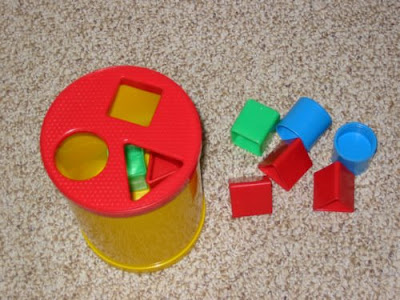
What happened next was magical.
Joy pulled the lid off the shape-sorter, dumped the shapes, and started working to get the lid back on (accomplishing it with just a smidge of help.) The barista handed her one of the shapes, and Joy went right to work trying to get it in (again with just minimal help). Once she succeeded in getting the edges lined up correctly in the proper hole, she paused... and looked at the barista... and twinkled with anticipation.
The barista built the anticipation with a rising tone of "ahhh... ahhh..." (Imagine winding your way up to a theatrical sneeze.)
After teasing through several sounds of anticipation, Joy let the piece fall into the bucket, and began giggling like crazy, getting rewarded with praise and a tickle.
They did this again... and again... and again. They went through the entire bucketful two times, and then it was time for record keeping and the barista had to go fill in the binder. But Joy wasn't done. She went through another whole iteration of the bucket with me! And then I got up to go check on Rose, and Joy still wasn't ready to be done. She took the lid off once more all by herself, got out four pieces, got the lid back on, and ran the show all alone for two pieces' worth, looking all the way across the room to where I stood at the doorway, to make sure that I was watching and reacting appropriately.
After that we had to say goodbye to our guests, sing the ByeBye song after the report had been written so the barista could get out the door, and get ready for dinner.
There ya go. How's that for a House Blend session?
Right now we've got the playdate thing happening once a week. The rest of the sessions at our house are generally one-on-one, though Rose inserts herself into the action from time to time. Then twice a week we have sessions at Joy's daycare, with a very different dynamic among a roomful of peers (I'm never around to witness these since I'm always at work, but she's been able to do some neat things with support like join in on dress-up play.) At this point we've got 12 sessions on the schedule per week.
It's not always this awesome, by a long shot, but it's fun to share a good one!
By the way. J-Cat's mom is very pleased with these playdates too (besides being a phenomenal partner as the action is taking place). All this structured turn-taking practice is GREAT stuff for J-Cat as well as for Joy.
Besides, we had rather an amazing session with Joy's Tuesday-afternoon barista, that I'd like to share.
This was a 3pm-5pm afternoon session; the House Blend sessions are two hours long, minus 15 minutes at the end for record-keeping.
We have a consistent routine to begin and end the sessions, something that started all the way back with one of Joy's first Birth-to-Three therapists in 2006. At the beginning of the session comes a song to the tune of "Goodnight, Ladies" that goes:
Hello Joy,
Hello Joy,
Hello Joy,
It's time for us to play!
At the end of the session comes a song with three verses (I don't know a name for the tune): one verse for clapping hands, one for stomping feet, one for waving bye-bye. We have tiny reminder-notes taped to the outside and inside of the front door to help make sure that the songs happen.
The timing of the afternoon sessions is such that it generally starts with snack.

Joy has become a pro at yanking and handing over the photo cards. In fact, there was one snack over the weekend where we wanted to serve her something that wasn't on the photos, so we didn't bring the book out, and she was mildly cranky at not having her useful tool available! (She wasn't upset enough to refuse the tortilla chips... But I digress).
So after a suitable run of repeated photo requests for small servings of bunny-cracker and apple and milk, it was over to the living room for some jumps and pillow-squishes. I think that's all they had time for before our playdate guests arrived!
Since I have to be at home for these afternoon sessions, I'm no longer available to pick Rose up from school. Instead she comes home with neighborhood friends, a lovely family with a Rose-aged daughter and a 3-year-old son. Wonder of wonders, the mom is an early-childhood therapist (ST) herself and "gets" our situation without all the effort of edu-ma-cating on my part.
Joy's playdate was with the son. We'll call him J-Cat, short for Jellicle Cat because he is currently fascinated with the musical Cats. I could totally see him as Mr. Mistoffelees in the 2030 Broadway-revival...
As soon as boots and snowpants were shed, Rose and her pal disappeared into a back room, and J-Cat and his mom came to join Joy in the livingroom. J-Cat gravitated to a bag full of soft-blocks, so that became the first game. The barista held Joy between her legs, J-Cat sat between his mom's legs, and they took turns trying to toss a soft-block to the other. We used short verbal cues for things like "Joy's turn!" "Catch!" "Ready, set..." (wait for Joy to maybe chime in...) "GO!" And lots of encouragement & cheering & praise. Joy took a lot of support to play the game, but tolerated it -- like all things, up to a point.
When Joy started protesting, we cajoled her into "one more turn" and then it was her turn to pick the next game. The barista whipped a couple of toy photos onto the notebook, and Joy picked the Farm See-n-Say. So then the See-n-Say passed back and forth, with each kid getting a turn to pick an animal and pull the lever.

"Joy's turn!"
"Pull!"
"Duck... quack, quack."
"OK, J-Cat's turn!"
"Old McDonald had a farm, E-I-E-I-O!" (everybody claps along, Joy with support)
Joy didn't say much, but she made definite selections when offered choices, and took good turns with pulling or pushing or whatever the toy was. We played ring-stack, and blanket-pulls, and a train-toy, and another See-n-Say (an older bigger one with a stiffer lever, featuring baby zoo animals), and mini-trampoline jumping, and tunnel crawling. Joy needed some jump-breaks from time to time, while J-Cat needed some breaks to sing and dance for us.

After about an hour, both kids had hit their limit of such structured turn-taking. J-Cat wanted to play an imaginative game with his mom involving play-food, not one of Joy's strengths. So while they did that, somehow the very basic 3-hole shape-sorter came out as something for Joy & the barista to do.

What happened next was magical.
Joy pulled the lid off the shape-sorter, dumped the shapes, and started working to get the lid back on (accomplishing it with just a smidge of help.) The barista handed her one of the shapes, and Joy went right to work trying to get it in (again with just minimal help). Once she succeeded in getting the edges lined up correctly in the proper hole, she paused... and looked at the barista... and twinkled with anticipation.
The barista built the anticipation with a rising tone of "ahhh... ahhh..." (Imagine winding your way up to a theatrical sneeze.)
After teasing through several sounds of anticipation, Joy let the piece fall into the bucket, and began giggling like crazy, getting rewarded with praise and a tickle.
They did this again... and again... and again. They went through the entire bucketful two times, and then it was time for record keeping and the barista had to go fill in the binder. But Joy wasn't done. She went through another whole iteration of the bucket with me! And then I got up to go check on Rose, and Joy still wasn't ready to be done. She took the lid off once more all by herself, got out four pieces, got the lid back on, and ran the show all alone for two pieces' worth, looking all the way across the room to where I stood at the doorway, to make sure that I was watching and reacting appropriately.
After that we had to say goodbye to our guests, sing the ByeBye song after the report had been written so the barista could get out the door, and get ready for dinner.
There ya go. How's that for a House Blend session?
Right now we've got the playdate thing happening once a week. The rest of the sessions at our house are generally one-on-one, though Rose inserts herself into the action from time to time. Then twice a week we have sessions at Joy's daycare, with a very different dynamic among a roomful of peers (I'm never around to witness these since I'm always at work, but she's been able to do some neat things with support like join in on dress-up play.) At this point we've got 12 sessions on the schedule per week.
It's not always this awesome, by a long shot, but it's fun to share a good one!
By the way. J-Cat's mom is very pleased with these playdates too (besides being a phenomenal partner as the action is taking place). All this structured turn-taking practice is GREAT stuff for J-Cat as well as for Joy.
Sunday, February 1, 2009
The Best Social-Communication Teacher
When we first got Joy evaluated and into the Birth to Three early intervention program, we had an interesting stroke of luck.
The program was short on speech therapists, didn't have one to assign to us right away, so gave us something else instead. I got a couple of months of weekly training in parental techniques to encourage communication, using the Hanen program and the book It Takes Two to Talk. (There's another version of the program that's focused on ASDs, called More Than Words, but we didn't have a diagnosis at the time.)
The Hanen training gave us a magnificent foundation for getting more out of Joy's communication, turning us into better Joy-listeners and communication partners.
The Hanen program was founded in Canada for the very situation that we were facing: frustration with long waits for professional speech therapists, families who needed to get started "right now." It's an incredibly empowering approach. As their site says,
Some of the highlights of the Hanen program, for me:
I found that a lot of this came pretty easily to me, once I took the time to think and practice. Of course there were many more steps, and thought-exercises, and we also got several video-taping sessions with the speech therapist who was leading the training so she could comment and critique how we were putting the principles into practice. It was simply thrilling to see Joy respond.
Well, another reason we ended up doing Joy's intensive autism therapy with Agency 2 and their House Blend was that their approach builds on similar principles. In fact, the James MacDonald (PhD) that I've mentioned before was involved in developing the Hanen program early on, and much of that work is evident in the Communicating Partners program that he later developed. His latest book, Play To Talk: A Practical Guide to Help Your Late-Talking Child Join the Conversation, co-authored by Pam Stoika (PhD), is a highly-readable explanation of the approach and strategies. (Plus it's reasonably priced, what a bonus!)
The parent-empowerment agenda is powerfully stated on the very first page.
So, the Play to Talk / Communicating Partners training was what we layered onto the Hanen training when we were in limbo on the waiting list for intensive autism therapy, and we both wanted to keep moving forward and also start building our relationship with Agency 2.
Here's the gist of the Communicating Partners program: strategies that seem simple, but each of them can be unpacked pretty far and take quite a bit of effort and practice to really internalize!
All this represents another layer of our days with Joy, and the principles according to which our House Blend baristas are trained as well.
Upcoming layers: Joy's therapy goals, and how her school-district therapists fit into all this too. And maybe some bunnies.
The program was short on speech therapists, didn't have one to assign to us right away, so gave us something else instead. I got a couple of months of weekly training in parental techniques to encourage communication, using the Hanen program and the book It Takes Two to Talk. (There's another version of the program that's focused on ASDs, called More Than Words, but we didn't have a diagnosis at the time.)
The Hanen training gave us a magnificent foundation for getting more out of Joy's communication, turning us into better Joy-listeners and communication partners.
The Hanen program was founded in Canada for the very situation that we were facing: frustration with long waits for professional speech therapists, families who needed to get started "right now." It's an incredibly empowering approach. As their site says,
The goal of It Takes Two to Talk is to enable parents to become their child’s primary language facilitator, thereby maximizing the child’s opportunities for communication development in everyday situations.
Some of the highlights of the Hanen program, for me:
- An emphasis on meeting your child where she's at. This includes a very basic physical principle of positioning yourself to be really face-to-face with your child, rather than talking at her from on high. But it also entails letting you child show you what she's interested in, and paying close attention to her cues, and responding in a way that stands a good chance of drawing a further response. It Takes Two to Talk calls this the "Tuned-In Parent."
- An emphasis on playfulness and fun. As in, your kid's going to be much more interested in sticking with a social interaction if it's enjoyable all around. Let go of thinking that you have to make them talk (how many times have you heard an adult doing something like: "Hey, Joy, can you say 'spoon'? C'mon, say 'spoon' honey. Say 'spoon'!" and then she doesn't say 'spoon' and it gets totally un-fun for everyone.) Instead, enjoy what interactions they *can* do... maybe pretend to eat from the spoon. "Mm, good food!" then pass the spoon back and say "Joy's spoon!" and maybe she can pretend to eat too....
- One acronym I actually remember from the program, which is OWL, for Observe, Wait, Listen. Observe to see what your child is interested in. Wait to give her enough time to send you a message, whether a sound or gaze or action or whatever (it helps to lean forward and look expectantly, sending your own message that you are indeed waiting for a communication!) Then Listen for your child's message, paying attention to as many cues as you can. Even if you can't understand what her response, if you've waited and watched, you can often take a good guess and respond accordingly. Or else take a turn by imitating... and then OWL again to give your child the next turn in the interaction.
I found that a lot of this came pretty easily to me, once I took the time to think and practice. Of course there were many more steps, and thought-exercises, and we also got several video-taping sessions with the speech therapist who was leading the training so she could comment and critique how we were putting the principles into practice. It was simply thrilling to see Joy respond.
Well, another reason we ended up doing Joy's intensive autism therapy with Agency 2 and their House Blend was that their approach builds on similar principles. In fact, the James MacDonald (PhD) that I've mentioned before was involved in developing the Hanen program early on, and much of that work is evident in the Communicating Partners program that he later developed. His latest book, Play To Talk: A Practical Guide to Help Your Late-Talking Child Join the Conversation, co-authored by Pam Stoika (PhD), is a highly-readable explanation of the approach and strategies. (Plus it's reasonably priced, what a bonus!)
The parent-empowerment agenda is powerfully stated on the very first page.
If you are concerned about your child's social development, communication skills, behavior or learning, the first and most important thing to do is to find a person (or small team of people) to be your child's social language teacher. In our experience, your child will make the greatest gains with a social language teacher who is:Mothers and fathers, grandparents and guardians: go to the nearest mirror and look.
- Someone who is already a competent communicator, with words as well as gestures and non-verbal communication.
- Someone who will be available to teach your child in a variety of real-life settings, such as play time, chores, meals, family outings and daily routines
- Someone who your child likes and trusts, and who likes and trusts your child
- Someone who is familiar with and dedicated to supporting the cultural and family values you hold dear
- [the list goes on!]...
You just found your child's best social-communication teacher.
So, the Play to Talk / Communicating Partners training was what we layered onto the Hanen training when we were in limbo on the waiting list for intensive autism therapy, and we both wanted to keep moving forward and also start building our relationship with Agency 2.
Here's the gist of the Communicating Partners program: strategies that seem simple, but each of them can be unpacked pretty far and take quite a bit of effort and practice to really internalize!
- Balance: Do and say about as much as the child does and says. Allow child time to participate.
- Match: Talk and act in ways that are possible for your child. Talk and act in ways your partner can and will want to try.
- Respond: Let your child see that you are paying attention to his feelings, actions and words.
- Share Control: Be sure each partner has impact on the other, each partner has some control but not total control.
- Play and Affirm: Let your child see that you enjoy and value him just as he is.
All this represents another layer of our days with Joy, and the principles according to which our House Blend baristas are trained as well.
Upcoming layers: Joy's therapy goals, and how her school-district therapists fit into all this too. And maybe some bunnies.
Tuesday, November 25, 2008
Look Away, Look Away
When I get Joy out of the crib in the morning, we have a little routine. I open the crib-tent zipper, open the blinds, greet her with a cheery good-morning. Then depending on how asleep or awake she is, I may pat her, help her untangle from the blankets, eventually help her to her feet.
Then we have a little hug, and I say the word "hug."
Then I repeat the word "up" several times, and give her a chance to request it (something she used to never miss, but it went away one day a couple months ago and hasn't come back yet).
Then I count "Ready, set..." and give her the chance to say either "up" or "go," another prompt she never used to miss.
Then I fill in the "go" for her, and lift her out of the crib with a kiss, and her pyjama-ed little feet go padding out toward the living room and/or breakfast table.
She does not look directly at me during this entire routine.
At least for this eye-contact avoidance thing, I have a frame of reference: John Elder Robison's book Look Me In The Eye, in which he describes how difficult (and perhaps over-rated?) eye-contact can be.
I don't have as good a framework for Joy's other frequent visual avoidance situation, where she declines to look at whatever task she's doing with her hands. I supposed I should say "whatever task she's being asked to do with her hands," because it's most noticeable when it's something an adult wants her to do: link pop-beads, put in a puzzle piece, buckle herself into her booster chair.
The booster chair is a fascinating example. She's very good at climbing into the chair herself, and retrieving the three straps that have to buckle together, and fitting the buckle together and pushing each side in with a pop! but with her fingers out of the way so as not to get pinched. Except she generally does it without looking, other than perhaps peripherally. When she accidentally gets one side of the buckle turned backward, it's well-nigh impossible for her to correct without seeing what's gone wrong.
How to help Joy look at what she's doing, enough to see it, learn it, achieve it?
Physically giving her head a gentle re-direct seems rather ham-handed and invasive, but it does at least get her to see that the buckle is turned backward or whatever, and correct it herself. Calling to her with voice-prompt, making a noise by tapping the item, waving the item in front of her face... none of them very effective.
Thoughts?
Maybe she just wishes she were in Dixie -- Look away, look away!
Tuesday, September 30, 2008
Cause and Effect
In my last reflection on Joy's brush with craniosacral therapy, I mused about doing a post on cause and effect. Here 'tis.
It strikes me that there are two sides to cause and effect when it comes to how we evaluate what's going on with Joy's health and development. One has to do with what's going awry; the other has to do with what's going right.
I'm particularly interested today in the "what's going right" side of things.
We're trying different treatments and interventions with Joy all the time, in an elusive journey toward improvement / healing / wholeness.
There's the allopathic medicine side of things, such as the combination of strong medications we've brought to bear on Joy's epilepsy. We carefully track the seizures against the dosing. Funny thing here: the three times that we've almost gotten to a month without any knock-down seizures don't seem to correlate very directly with dosage changes, and yet without the meds we'd be in big trouble. (The one time that we tried to back down the dose of one of the two meds she's currently on, the seizures increased dramatically).
There's the non-traditional medicine side of things, like we tried with the craniosacral therapy, various attempts to bring healing through correcting flows of energy and such.
Then there's the educational realm of interventions that we're tweaking all the time, between three therapists from the school district. The intensive autism therapy I should perhaps put with the medical side of things, but the day-to-day interactions have a lot in common with what we're doing with the school district and we deliberately coordinate the two.
Then there's the fact that Joy continues to grow and mature.
What a complex and fascinating endeavor, trying to facilitate (and evaluate) all this potential growth/healing!
And somewhere, woven between all of this, is faith and mystery and miracle.
Some Boggle-playing friends of mine at church had an amazing experience lately that relates to this.
Their middle-school-aged son dislocated his knee earlier this month, a painful injury. The doctor was able to manipulate the knee back into place with quite a bit of effort, but it wouldn't stay -- it was popping back out with a fingertip's worth of pressure. The family requested the prayers of the congregation as they scheduled their son for surgery.
The day of the surgery arrived, the son was prepped for the procedure and placed under anesthesia, and then... the surgery didn't happen. The surgeon reported that the knee was back in place and healing well, staying put even when he pushed at it. Nothing in the literature suggested the possibility of that course of events.
"Are you religious?" the surgeon asked the parents.
There is much about the causes & effects of healing that is beyond our knowledge. I'm continuing to learn about being open to a range of healing, however it may come.
===========
Thank you to Barbara at TherExtras for precipitating this post. I hereby submit it for inclusion in her upcoming blog-carnival on healing, scheduled for October 6.
[Additional note: the mom of the lad with the inexplicably-healed knee did give me explicit permission to post the story!]
Thursday, September 11, 2008
All Lit Up
You know that the school year will get off to a good start when...
You tell your school-district team leader the name of your autism-therapy senior therapist, and her face lights up, and she says something to the effect of, "Oh good, we've worked together before, she does a great job and she runs her meetings so well too."
And then,
you tell your autism-therapy senior therapist the name of your school-district team leader, and her face lights up, and she says something to the effect of, "Oh good, we've worked together before, she's great to work with and has such good ideas."
The world needs more of that kind of light!
We are finally getting closer to having a full schedule with Joy's intensive autism therapy, plus this was the first week for her of seeing all three of her school district therapists, who work on an itinerant basis, coming to work with her at home and daycare. Joy's pushing back a little bit about all those hours spent with adults bugging her to be interactive and DO things, I think, but I'm hoping that she'll get used to the full schedule before too long.
Meanwhile, one more thing that's making my face light up -- since September 1, we've been on another string without knock-down seizures. Target date for month-a-versary party: October 1. We shall see.
Wednesday, August 27, 2008
In Praise of Awesome Daycare
I've mentioned Joy's daycare before, and officially dubbed her daycare provider "Lynda," after Lynda Carter of Wonder Woman fame. Today I'd like to let you know why we, and Joy, are so incredibly blessed in her daycare situation.
I work a part-time schedule. For the first two years of Joy's life, we had a daycare-swap arrangement with another family from church, who had a little guy only two days older than Joy. But after two years of swapping, the other family was looking to reproduce again and found another arrangement that would better suit an expanding family, so we needed to find something else. By that point, we were well aware that Joy was "behind" developmentally, and she'd been getting Birth-to-Three services for several months. We knew that we'd need something special, and we found it from a personal referral from a Birth-to-Three therapist, who had heard about what Lynda had put together in her home.
Lynda mixes things up with her daycare kids in two ways. She deliberately assembles a mixed-age group of children, regularly taking in new babies who then grow into years-long clients! And she deliberately puts together a mix of special-needs and neurotypical kids. Right now the mix is about half and half.
This daycare is a model of inclusion on a day-to-day basis, and she makes it look so easy. It really hit me the other summer one time when I dropped Joy off late and everyone was already out in the front yard, playing in a little wading pool. Lynda had the one girl with the most intense challenges (non-verbal, not very mobile, among other things) sitting on the bench of a little picnic table pulled up to the edge of the pool, with her feet in the water. Lynda was playfully pouring water over this girl's legs and feet, to a response of big smiles, while simultaneously tracking and interacting in turn with the other kids around the pool and in and out of the water, and managed to seamlessly welcome me and Joy as we arrived.
Lynda's place is therapy-central some days, with itinerant therapists from Birth-to-Three and the school district in and out to work with their various kiddie-clients. Joy's summer speech therapist was only there once this summer, working mostly out of our home, but her response to just one session at Lynda's was "This place is therapy heaven!" Lynda is eager to learn from the therapists and also make suggestions -- she's not a therapist by background, but has practically made herself into one by observation and continuing education.
Oh, and did I mention the reports? Every day during nap-time, Lynda writes up three or four paragraphs on each kid, with detailed specifics on their activities. Most days those messages are e-mailed to a private online group we have set up for Joy-reports, so JoyDad and I get to see them at work (only on the busiest days do they get handwritten). We've got the school-district therapists turning in their reports that way too, and Lynda's are easily the equal of theirs.
To top it all off, this week Lynda let me trade Joy-days because of vacation and holiday. I ended up having a day at home all to myself, though I did share it with JoyDad, swooped down on his workplace and whisked him off to a restaurant lunch.
Yes, she does read this blog -- thanks so VERY much, Lynda / Wonder Woman!
Thursday, July 24, 2008
How can you possibly choose?
Joy's big sister Rose, age 6, had to visit the doctor the other day. I took her because her teacher had been concerned about frequent urination -- Rose had been visiting the potty some 15 or 20 times a day. After ruling out infection, the pediatrician said, "Well, I could send you to a pediatric urologist, but I know the first thing that they're going to do, and so I may as well just prescribe it for her if you want." The automatic first-line therapy turned out to be a laxative, on the theory that an emptied bowel can't put as much pressure on the bladder.
Part of me would very much have liked things to be that simple when Joy's autism diagnosis came down!
But there is very little that is automatically recommendable when it comes to autism therapy. Autism comes in so many darn flavors, and it seems there's an argument about practically everything related to autism:
Agency 1's offering, ABA, is the therapy with the longest history and the richest publication history. ABA practitioners use positive reinforcements to elicit and reward behaviors (verbal, social, motor) step by step toward specific instructional goals. Enthusiasts claim a high success rate, raised IQs, and improved abilities to function in society. Critics say that if you're all about training behaviors, you get... a bunch of trained behaviors, and not much else.
Agency 2's offering puts the focus on relationships as the context for learning. The theory goes that first you work on eliciting an engaged, persistent, interactive relationship partner, and then you can work on specific content. Enthusiasts say that it only makes sense to start with relationships, because so much of autism has to do with relationship challenges, and point to great outcomes too. Critics say that it's a lot of money to pay for gussied-up playtime.
Even between these two very different approaches, I was feeling indecisive. (Think Tevye in Fiddler on the Roof: "On the one hand... on the other hand... on the OTHER hand...") In the Autism 101 session I attended in February 2007, one of the questions I asked was how in the world one decided between even those two options. The moderator of the session, president of the local Autism Society chapter, reassured me, "You'll know." She said that after reading up and then visiting both agencies, most families find it quite clear.
I didn't believe her, but she was right.
We did an initial intake visit to Agency 1 first. I was very impressed with the intake coordinator I had spoken with on the phone. But the expert who did the evaluation and modeled bits of the ABA therapy didn't get much joy out of Joy. She didn't "light up" for the little requested behaviors, just wanted the treats without the work. Plus when we mentioned the centrality of her sensory issues (all sensory-seeking, all the time!), the response was, "We don't believe in sensory integration disorder." Hmm.
Then came Agency 2. I hadn't had such a good phone experience with the intake coordinator, who was subbing for someone on maternity leave. But the expert who did the evaluation was able to elicit a very different Joy than the one who showed up at Agency 1. Joy seemed comfortable and happy, and ready to interact. Furthermore, we learned that sensory support was integral to their approach, on the theory that a child whose sensory needs aren't being met isn't going to be in the zone for much of any learning at all.
Bingo.
So Agency 2 is the outfit that we're now starting with. We had an initial workshop meeting at the beginning of the week, and have had several in-home sessions as our team members get to know Joy and the family. Joy has been receptive and charming so far; no surprise, as the initial sessions are structured to be very much child-led, so nobody's explicitly asking her to depart from her own agenda so far (though they are getting her to do a lot of interaction and game-playing that is very much their idea of how to expand on her agenda!)
The dilemmas about what kind of treatments to pursue weren't all said and done in this one decision, of course. We've still got the annual dance with the school district, and the whole epilepsy side of things, and more. But this is a big step and a big directional choice.
Part of me would very much have liked things to be that simple when Joy's autism diagnosis came down!
But there is very little that is automatically recommendable when it comes to autism therapy. Autism comes in so many darn flavors, and it seems there's an argument about practically everything related to autism:
- What causes it
- Whether or not it's curable
- Whether or not one should even approach it in terms of a cure
- What therapies are useful
- Who should pay for what
- and on and on.
The therapies themselves are a stew of acronyms and fancy monikers: DAN, ABA, DIR/Floortime, RDI, Sonrise, GFCF diet, nutraceuticals and more. And our doctors were willing to provide information sources and opinions, but we didn't get prescriptions. The legwork and the decisions were to be ours.
The answer to what therapies are useful depends to a great extent on what you believe you're treating. In Joy's case, we had a genetic explanation ready to hand (the linear nevus sebaceous syndrome), and since there's no miracle fix for that one, our focus from the beginning has been on support and education and quality of life all around.
The decision-making was helped only somewhat by the intensive therapy options approved by the state of Wisconsin and offered in our county. As I mentioned in my last post, there are two options for going down that road: Agency 1 offering Applied Behavior Analysis (ABA)., and Agency 2 offering a house blend of relationship-based therapy, heavily reliant on DIR/Floortime and the Communicating Partners work of Dr. James MacDonald.Agency 1's offering, ABA, is the therapy with the longest history and the richest publication history. ABA practitioners use positive reinforcements to elicit and reward behaviors (verbal, social, motor) step by step toward specific instructional goals. Enthusiasts claim a high success rate, raised IQs, and improved abilities to function in society. Critics say that if you're all about training behaviors, you get... a bunch of trained behaviors, and not much else.
Agency 2's offering puts the focus on relationships as the context for learning. The theory goes that first you work on eliciting an engaged, persistent, interactive relationship partner, and then you can work on specific content. Enthusiasts say that it only makes sense to start with relationships, because so much of autism has to do with relationship challenges, and point to great outcomes too. Critics say that it's a lot of money to pay for gussied-up playtime.
Even between these two very different approaches, I was feeling indecisive. (Think Tevye in Fiddler on the Roof: "On the one hand... on the other hand... on the OTHER hand...") In the Autism 101 session I attended in February 2007, one of the questions I asked was how in the world one decided between even those two options. The moderator of the session, president of the local Autism Society chapter, reassured me, "You'll know." She said that after reading up and then visiting both agencies, most families find it quite clear.
I didn't believe her, but she was right.
We did an initial intake visit to Agency 1 first. I was very impressed with the intake coordinator I had spoken with on the phone. But the expert who did the evaluation and modeled bits of the ABA therapy didn't get much joy out of Joy. She didn't "light up" for the little requested behaviors, just wanted the treats without the work. Plus when we mentioned the centrality of her sensory issues (all sensory-seeking, all the time!), the response was, "We don't believe in sensory integration disorder." Hmm.
Then came Agency 2. I hadn't had such a good phone experience with the intake coordinator, who was subbing for someone on maternity leave. But the expert who did the evaluation was able to elicit a very different Joy than the one who showed up at Agency 1. Joy seemed comfortable and happy, and ready to interact. Furthermore, we learned that sensory support was integral to their approach, on the theory that a child whose sensory needs aren't being met isn't going to be in the zone for much of any learning at all.
Bingo.
So Agency 2 is the outfit that we're now starting with. We had an initial workshop meeting at the beginning of the week, and have had several in-home sessions as our team members get to know Joy and the family. Joy has been receptive and charming so far; no surprise, as the initial sessions are structured to be very much child-led, so nobody's explicitly asking her to depart from her own agenda so far (though they are getting her to do a lot of interaction and game-playing that is very much their idea of how to expand on her agenda!)
The dilemmas about what kind of treatments to pursue weren't all said and done in this one decision, of course. We've still got the annual dance with the school district, and the whole epilepsy side of things, and more. But this is a big step and a big directional choice.
Meanwhile, about Rose and her potty trips. The laxative had an immediate and pronounced effect, at the lowest dose, and it's not the one you're thinking! It was a placebo effect. The very first day Rose took the medicine and started having to keep track of her potty trips, the number of trips dropped down to something like four or five.
Who knows what therapies are going to produce what results?!
Tuesday, July 22, 2008
Intensive Therapy: Out of the Starting Gate
Finally, finally! Yesterday morning Joy had her very first session of state-funded intensive autism therapy, almost nineteen months to the day after receiving the diagnosis of autism (just before Christmas, December 2006).
The first time we visited her primary care pediatrician after the developmental pediatrician made the pronouncement, she told us that we were fortunate that Wisconsin has such a fine program for intensive autism therapy.
Well, yes and no.
There's indeed a fine program in Wisconsin, funded in part by a special federal waiver that allows Medicaid funding to be spent for early autism therapy, without requiring that the families be in poverty to qualify. Each qualifying child can get up to three years of intensive therapy, with ongoing "post-intensive" dollars to follow. The problem is that the funding has not kept pace with the demand, and the waiting list is growing to frustrating proportions.
There's a fair amount of agreement that the gold-standard in inter-personal therapy for autism treatment involves 30+ hours of therapy per week, and the earlier you get started, the better. There are a number of intensive-level therapy programs & approaches out there, and our county offers a choice between two agencies that operate with the Medicaid waiver funding. More about the choices and their content later! What seems to be the commonality across the various philosophies is the many many hours of one-on-one face time, with lots of interactions and lots of documentation. And ideally, the therapist should be the most interesting and engaging thing in the room.
As you can imagine, this sort of intensity isn't cheap. Out-of-pocket, it's up to $60,000 per year, out of reach for most middle-class families unless you double-mortgage your home and drain your retirement funding and fundraise like crazy. We chose not to do so, instead continuing to pursue what therapy we could get for Joy through the Birth-to-Three early childhood program, and more recently through the school district.
I started making calls on the very day Joy got that autism diagnosis, knowing that the wait was long and getting longer. It was nearly two months before we waded through the initial paperwork and got a visit from a county worker to make sure that Joy looked like intensive-therapy material, and then two months more before they got all that paperwork processed and got her officially onto the waiting list, April of 2007. And then the months started clicking by. When she'd been on the list for a YEAR, the county sent someone out to "re-screen" her and make sure that we hadn't had some sort of magical recovery...
In the meantime, we've gotten involved in advocacy, both for Joy's sake and for others coming down the pike onto that awful waiting list. One of the ways that Wisconsin has attempted to rescue the intensive-therapy program without directly ponying up the money it would take to get everyone off the waiting list and into the program, is to require insurance providers to pick up some of the therapy. Currently, insurance providers in Wisconsin are NOT required to cover anything autism-related, so they don't. This year's attempt to make the insurance companies do the right thing went down in flames at the end of the legislative session, when the leadership of the Wisconsin Assembly used a weaselly substitute amendment to keep the autism insurance bill from coming to the floor (where it probably would have had the votes to pass!)
November's elections are very important...
Anyway, we're very happy to have the therapy available, and very happy to have two fully-funded choices. Not everybody has that advantage, and we're well aware of it. We're cranky beyond belief, however, about that waiting list. Talk about wasting public funds, letting the precious optimal months slip by!
We'll continue with the advocacy, of course. But now it's our turn for the therapy, and we're going to do our best to make sure that it's as helpful for Joy as it can possibly be.
Subscribe to:
Posts (Atom)