Saturday, May 8, 2010

Product Hits and Misses: Universal Design Edition

In honor of the LEND program from which I just graduated yesterday (!!), I've got one more seminar topic to pay forward.

So for quite a few years, the vegetable peeler of choice in my kitchen has been the Good Grips peeler from OXO. It's got a comfy wide handle, it's sharp as the dickens, and it slices off a nice thin reliable peel every time. Been using it for years.
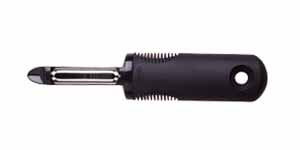
Good Grips Swivel PeelerWhat I didn't know until recently was that this product was originally designed to make vegetable-peeling more comfortable for people with arthritis -- as well as everyone else. Now, if they'd viewed and advertised it solely for the arthritis market, it would have been a tiny little adaptive niche item, sold in special needs catalogs, nobody who didn't have arthritis would have thought to buy it and even those who did would be aware of a certain stigma of using such an item ("sigh, it's a great product but it just makes me feel so old!") But that's not what they did. They had the foresight to realize and capitalize on the fact that what was good for arthritis in this product would be good for a whole lot of people, with or without vegetable peeling challenges -- and they've got a whole line of highly popular kitchen utensils now.

The Good Grips peeler is a fine example of Universal Design.

Universal Design is defined as "the design of products and environments to be usable by all people, to the greatest extent possible, without the need for adaptation or specialized design." The concept rests on seven principles, which are spelled out in detail at the Center for Universal Design at NC State University. I'm going to list just the principles and their basic definitions here:

Principle One: Equitable Use -- The design is useful and marketable to people with diverse abilities.

Principle Two: Flexibility in Use -- The design accommodates a wide range of individual preferences and abilities.

Principle Three: Simple and Intuitive -- Use of the design is easy to understand, regardless of the user's experience, knowledge, language skills, or current concentration level.

Principle Four: Perceptible Information -- The design communicates necessary information effectively to the user, regardless of ambient conditions or the user's sensory abilities.

Principle Five: Tolerance for Error -- The design minimizes hazards and the adverse consequences of accidental or unintended actions.

Principle Six: Low Physical Effort -- The design can be used efficiently and comfortably and with a minimum of fatigue.

Principle Seven: Size and Space for Approach and Use -- Appropriate size and space is provided for approach, reach, manipulation, and use regardless of user's body size, posture, or mobility.

We had some interesting small-group work in the seminar, each table of students analyzing a group of products that were placed on our table, and then making forays through the building to critique design issues from the perspective of case-study scenarios -- if you were a person with certain challenges and needed to do a certain daily-living sequence of tasks in the building, how does the current setup help or hinder?

It made me think of some everyday products and some recent experiences with Joy.

Consider these two battery-powered toothbrushes:


The Dora-toothbrush on the left, from Colgate, is the first one we tried when we decided to try the battery-powered toothbrush thing with Joy. It was a good success. She can turn it on and off herself with minimal support (the pink buttons just above Dora's head), and likes the feel of it in her mouth.


However, eventually it wore out, and when I went to get another one (I think I'd forgotten which store I'd gone to), the Colgate/Dora one wasn't there. So I grabbed the one on the right, the Little Mermaid from Oral B.

Not a good move. Not only was the toothbrush kind of ugly -- the lithe form of the Little Mermaid doesn't lend itself well to wrapping around batteries! Look at the on/off switches -- the on switch is right between her clam-shell bikini, while the lower button approaches her maiden-bits. Why didn't the designer dude (it HAD to have been a guy) just put the on-off switches horizontally, press the right clamshell for on and the left for off -- but I digress. More importantly, the buttons were hard to push. Joy couldn't summon that extra force, and got very frustrated with it. In addition, the bristle-movement was more extreme, and if you didn't get the brush into your mouth right away (and Joy's not that fast with it), it would fling little bits of toothpaste around.

Big universal-design fail on the "low physical effort" principle, plus being ugly and kinda demeaning. We went back out and sought Dora in particular. Accept no substitutes.

Here's another example from our everyday life -- the door handles of our two vehicles.

Our Honda CR-V, which we've had for 10 years now:


Joy cannot yet operate this handle. It takes a pretty sturdy pull, and you pretty much have to wrap your hand around the handle to do it. (Principle 6, low effort). It also doesn't pull straight out, but pivots such that the right side stays in place and it's really the left side that you're pulling out (Principle 3, intuitive).

Fortunately things are better from the inside, when it comes to pulling the door shut:


Look at that nice long snaky handle, with multiple places and heights to grab and pull. You could even use that holder-space lower down as a place to pull if that were more comfortable for you. (Since we have the child-lock on at all times, the door-open handle from the inside doesn't enter our calculations at this point). Joy does well at pulling the door closed, though it's kind of a heavy door and does take some effort.

Then we have our new car, the Honda Fit that we got just about a year ago. With this car, Joy can let herself in.


The handle pulls up, pivoting along the entire top length, with a minimum of effort. As long as you get your fingertips under, you don't have to wrap your hand or anything.

But oh no, what did they do to the inside?


There's only one little place to put your hand and pull. And it's only at one height, which isn't a good height for Joy because she's buckled into a car-seat by the time she needs to close that door. Fortunately she can do it if she stretches. And the door pulls easily, which is a plus. But why couldn't they have provided options, like the long snaky inside pull-bar did in the CR-V? (Principle 2: Flexibility in Use.)

I want to leave you with one final statement here, something that one of my LEND-trainee colleagues quoted in his final Leadership Presentation the other week. The quote applies to systems of health care, and it struck me as really thought-provoking, implying the applicability of universal design for systems well beyond toothbrushes and veggie peelers and car door handles:
Delivery models that work for populations with special health care needs will have applicability for everyone.

It's not just about what's good for special needs. It's about what's good for ALL of us. Universally.

To all my readers -- thank you for providing a sounding board and the opportunity for me to reflect on this year's LEND experience. This has really been a pivotal year for me in moving toward what I want to be when I grow up! :-) The journey continues, and it's so good to have so many people sharing that journey with me.

Wednesday, May 5, 2010

Reflected


Enlightenment is like the moon reflected on the water.
The moon does not get wet, nor is the water broken.
Although its light is wide and great,
The moon is reflected even in a puddle an inch wide.
The whole moon and the entire sky
Are reflected in one dewdrop on the grass.

-- Dogen (Japanese Zen Master)

Monday, May 3, 2010

A Tale of Two Surgeries

We've been moving toward two different outpatient surgeries for Joy, for a while now.

One of them has to do with the scar from her nevus-removal. Joy had three surgeries in her second year of life to remove the nevus-sebaceous "blotch" from her scalp, so that it would not run the risk of cancerous changes later in life. Cosmetically, it was good to have it gone too! It healed up quite neatly, but her scalp stretched as her head grew, and now the scar is about a quarter-inch wide. Nobody notices it when her hair is long, but last year when she had a buzz cut so she wouldn't pull out all her hair by the roots, you could see it pretty clearly:

Nevus Removal Scar, 3 years out

Way back when she had the surgeries, the plastic surgeon advised us that we'd probably want to do a scar-revision surgery once Joy's head had grown, maybe before kindergarten -- and that our insurance generally covered scar-reduction because it was a follow-up to the original covered surgeries. We were going to get it done last summer, but then we had other health issues to contend with and decided to wait till this year.

Meantime, we discovered that Joy has a small umbilical hernia. With many kids, little childhood umbilical hernias close up on their own by the age of 5 or so. And when it's as small as Joy's is, even past age 5 they'd normally leave it alone. But we've got a bit of a family history -- JoyDad had such a hernia that "popped" on him as an adult (as in, lots of pain and two surgeries, one on an emergency basis). Plus, Joy has unusual pain responses and isn't reliably able to show us where it hurts, just in case things did go wrong with hers.

Fortunately, the surgeons to do both procedures are in the same network. Joy's pediatrician helped us come up with the clever idea to do both the procedures in one event, so we'd only need one go-around with the anesthesia. The surgeons agreed, their schedulers got us all set up, we were on the calendar for June 2...

And then our insurance denied the scar revision. JoyDad went to a hearing to make our case, and they denied it a second time. Further pursuit of the case might involve legal consultation, and would certainly not be settled in time for the scheduled surgery date.

Our current plan is to pursue the hernia repair, but not the scar revision.

Thought experiment: what if these surgeries were for Rose instead of Joy? Would we react differently?

I can tell you right now, for Rose the scalp-scar would be a BIG DEAL. She's sensitive about her appearance, sensitive about teasing. If she reached adolescence with such a scar, it would be an emotional issue and a decided challenge to overcome (though I've no doubt she'd deal with it if need be). Pushing the case would be worth some sacrifices. I think I'd feel the need to at least consider the out-of-pocket option.

If Rose had the hernia, however, we could let it ride. She could tell us immediately if something did get to the point of hurting.

Meanwhile, Joy has shown no self-consciousness whatever about her appearance so far (and why should she, adorable as she is, in our unbiased opinion?!) She interacts with mirrors enough to be drawn to them and make funny faces -- does that mean she knows its her, though? As far as noticing teasing, we've been fortunate that she hasn't encountered it yet. Though of course she's off to school in just a few months.

But it doesn't take a scar to mark Joy as different.

Given where we are right now, and what we know about autism and about the world: the people who are sufficiently open of spirit to accept Joy for the amazing person she is, are going to be entirely unfazed by the presence of that scar.

The people who are going to be cruel to her will find plenty of differences before they even notice her scar.

Plus, the scar may simply never matter to her, even if/when she becomes aware of it. And if it does turn out to matter? Maybe that's something she ought to get to decide when she is at a point to be making such decisions.

With the hernia, though, that could potentially turn into a medical emergency. Even, possibly, way down the road when JoyDad and I might not be around, and nobody remembers that JoyDad had a hernia history. And we can't guarantee that Joy will be able to communicate about it.

So we're on the calendar for a hernia fix, still in early June. Think good thoughts for us, that the surgery goes smoothly and doesn't put any major setbacks into Joy's wonderful developmental progress these past weeks, and that we've made the wise call.

Saturday, May 1, 2010

The Funniest Thing in the World

Want to make Joy double over with giggles?

Take a pinch of shredded parmesan cheese between your fingers and let it sprinkle down over a plateful of food.

Funniest thing in the world!

Even better is that she gets all of us to laugh with her! She anticipates the delight, waits for the cheese to come out of its container, and signs "more" through her gales of laughter. (It's a good thing we like parmesan!)

I don't have a clue why the sprinkling of parmesan cheese should elicit such a reaction, but the giggles are simply priceless.

Monday, April 26, 2010

Spring Bouquet

Spring Bouquet

Photo by JoyMama.

Bouquet, and vase, by Rose.

Flowers by the Creator, by way of the JoyFamily backyard.

Saturday, April 24, 2010

Pacing the Crazy (legs)

The other week I mentioned (in passing) that I was training for an 8k race, the Crazylegs Classic. Which took place this morning.

In the spirit of the Many post, perhaps I should have mentioned that between the run and the walk versions of the event, there were almost 20,000 participants registered. And I went alone, though I was technically part of a team from the university library system. One consequence of Joy's full therapy schedule is that I generally can't bring family along to cheer when I race, so this was a solo event in a sea of many.

To get that many runners onto a course, you can't start everybody all at once. The top-flight runners get to start first, and then everyone else gets assigned to a different clump of runners depending on your pace. I was in the 36th wave out of 44, which meant that since they were trying to start one wave per minute, my wave started over ten minutes after the race had already been won.

But the neatest thing happened as I lined up with my fellow potential-slow-pokes. I ended up standing next to another mom, just about my age, who was running her first 8k race. And she just happened to have a little daughter with special needs. Like epilepsy. And a tendency to slip away and escape. And communication issues. And a high pain tolerance.

We chattered non-stop while we moved slowly up to the starting line. And then we ran together and kept each other going, surely faster than either of us would have been alone. We had each (optimistically) guessed that we'd make an 11-minute-mile pace, which is what got us assigned to the same wave. I ended up being just a little slower in the last half-mile where she was able to pull ahead -- but she was waiting for me at the finish line. We'd both run the entire way.

My pace per mile was 10:20. Woo hooooo!

I hadn't thought that blogging about an 8k race would be about special-needs mamas helping one another out. But there you have it.

Friday, April 23, 2010

Me, Too?

The other day when we were playing out on the deck (Joy was pedaling around the deck on her trike, woo hoo!), Rose asked an unexpected question.

"Do I have a little bit of autism too?"

I wish I'd thought to ask her what exactly was on her mind.

Instead I said something like, when someone has one little thing that's part of autism, we don't call it autism. You have to have a lot of things that are part of autism for it to be autism. But probably most people have one or two or more little things.

And then something else interrupted the conversation, I don't even remember what.

I hope the question comes up again, though.

I'd really like to know what was up.