Showing posts with label language. Show all posts

Wednesday, January 5, 2011

Included: Gifts in Her Name, Words in Her Mouth

This Christmas Joy and Rose both brought gifts home from school for their parents. Rose's gift to JoyDad was especially fine -- a calendar with the following image:

Calendar from Rose
"Hot peppers are red
Your guitar is blue
You are my dad
And I love you."

As far as gifts from Joy went, it felt like something of a new era. There was a little "I (heart) Mom" pillow for JoyMama, a calendar for JoyDad (what are they trying to tell him?), and a lovely pair of red beeswax candles for both of us that we've been lighting for a festive touch at meals.

Gifts from Joy

It felt really sweet to get gifts from Joy. I was happy to see the inclusion aspect of it too -- this was something the rest of her classmates were doing, something the teacher had thoughtfully organized and parent volunteers had facilitated. I witnessed some of the other kids taking their turn to make candles and saw as how it was mostly grown-ups doing the work, though I think the kids were proud of "their" candles.

I do wonder to what extent Joy had any idea what was going on. She may or may not have been able to have any hand at all in the making of them.

I have some similar wonderings about another procedure that's a regular part of Joy's school day. It's the routine during circle-time at the beginning of the morning where the kids take turns standing up and sharing their news since last they met. Joy participates in this via a GoTalk 4, on which we can record spoken messages that play back when she pushes a picture-button. The standard picture for "news" is a star. (The other button you see on the image is how she says "yes please" or "no thank you" to hot-lunch for that day.)

Joy's GoTalk
As with the gifts, this is a routine with a very sweet feel to it. Every morning, I come up with something for her to share. Monday it was "My Grandma and Grandpa came to visit from Kansas." Tuesday we had "I sat on my new rocking chair." I always try to make it something relatively normal-sounding, that the other kids can relate to. After all, this is one of the few consistent times of the day they'll be in one another's company! Rose provides the voice, and does a fantastic job. Joy's teacher and I are both charmed at the way Joy "speaks" in her sister's voice.

The benefits of this are many. Joy gets to take part in a classroom routine. Rose gets to help her sister. Classmates get a little window into Joy's world.

And yet, we're putting words into Joy's mouth every day with this routine, words she did not choose. Words that she can't (yet) choose. Is this befitting the dignity of a six-year-old human being, who does after all have her own thoughts and feelings and opinions? Is it that much different than if one used the GoTalk to make your favorite dolly "talk" by hand-over-hand causing dolly to push that button?

I'm not entirely sure. At this point, I feel we can justify it from a "fake it till you make it" perspective -- one day Joy will learn to share her own news, while dolly never would! -- in addition to all the other positives I pointed out.

As with everything we do in service of inclusion, we'll have to keep re-evaluating as we go.

Sunday, December 19, 2010

Eggy Bake

It's an unusual weekend around here. JoyDad is off in North Carolina, celebrating the newly-minted PhD earned by his sister, Auntie Running-at-the-Mouth. We're all mighty proud of her! but Joy and Rose and I get to be proud from a distance.

Rose especially is missing her daddy, so I've tried to add some extra fun to the weekend. One of the fun things we did Friday night was to make an unusual meal, a meal beloved by the female contingent of our little household, but of which JoyDad isn't a great fan (and especially not for dinner): Eggy Bake.

Eggy Bake is a dish I learned way back in high school at a service-week I did with some other volunteers in Ontario one summer. Very simple, all the ingredients are household staples, and you serve it hot with maple syrup. The name I learned it by is Aggkaka, a Scandinavian title and treat -- but the name just sounds so gutteral and scatological, I just couldn't bring myself to call it that with the kiddos.

However, Rose was on the ball. "Is it really called Eggy Bake?" she asked while devouring her portion, having glanced at my recipe and noticed another title. "No," I fessed up, "the real name is Aggkaka. But I call it Eggy Bake because 'Aggkaka' doesn't sound so great."

"Aggkaka? Why doesn't that sound great?" she persisted.

Oh sh..., I mean, crap, that is, caca! I wasn't planning this vocabulary lesson!

"Well honey, in some languages 'kaka' with a K means 'cake,' like in Swedish I think. But in other languages like Spanish, 'caca' with a C means... poop."

Her eyes opened a little wider. "Oh," she said, "I think I'll keep calling it Eggy Bake too, then."

Down at the other end of the table, her younger sister was inhaling her own serving with delight (and independently with her fork!) Between bites, we suddenly heard Joy's comment on the situation:

"Uggh...ka...ka!"

========

Here's my Aggkaka / Eggy Bake recipe, exactly the same as I found it on this website when I went scouting around to confirm that people really do call it "Aggkaka":

2 T. butter
3 eggs
2 c. milk
1 c. flour
2 T. sugar
1 t. salt

Melt 2 T. butter in a 9x9 baking dish at 425 degrees. For batter, beat the rest of the ingredients together. Pour batter into the hot butter. Bake 20-30 minutes or until set and golden brown. It will fall when you take it out -- don't worry!

Serve warm with syrup. Serves 4 (but 3 hungry JoyFamily ladies can polish it off no problem).

Friday, June 11, 2010

The Power of Words

As I think I've mentioned before (and you may have noticed!), I love to play with words. There are so many of them, and they're flexible and resilient at the same time, and the possibilities for interesting combinations are practically endless!

They also wield incredible power.

In 1987, Mayer Shevin wrote the following poem, called "The Language of Us and Them," reflecting on how people without disabilities speak about themselves and about people with disabilities.

We like things.
      They fixate on objects.
We try to make friends.
      They display attention-seeking behaviors.
We take a break.
      They display off-task behavior.
We stand up for ourselves.
      They are non-compliant.
We have hobbies.
      They self-stim.
We choose our friends wisely.
      They display poor peer socialization.
We persevere.
      They perseverate.
We love people.
      They have dependencies on people.
We go for walks.
      They run away.
We insist.
      They tantrum.
We change our minds.
      They are disoriented and have short attention spans.
We are talented.
      They have splinter skills.
We are human.
      They are.......?

You can read about the heartbreaking inspiration for this poem on the Autism Society of Middle Tennessee's web site.

While the poem wasn't originally about autism, it fits strikingly well with how "we" define "them" when it comes to the autism spectrum. I first heard these words in the autism context back in March, at the start of Paula Kluth's workshop at the Autism Society of Wisconsin (ASW) conference. When I walked in a little late, there was a video playing on the big screen, in which the words of the poem were being presented in the context of autism, with music and images and additional text. At the time I didn't even catch the name of the DVD, but I later learned that it was called "The Power of Words: How We Talk About People With Autism Spectrum Disorders Matters!" The creator is Judy Endow, MSW, autism consultant and self-advocate.

It was just announced on the ASW online mailing list that the video has been selected to receive the 2010 Autism Society Media Excellence award, to be presented at the July national conference of the Autism Society of America in Dallas. Congratulations to Judy! (Though there'd be no reason for her to remember me, I've heard her speak and met her briefly. Her words have taught me much -- and made me think.)

The DVD is sold online at the Autism Aspergers Publishing Company.

Here's one more text-excerpt from "The Power of Words" taken from the publishing company web site above:
One time I started making a turkey sandwich.
Then I remembered
I had a banana that needed to be used up.

So I decided to make
a peanut butter and banana sandwich
instead.

The group home worker
looked at the new person
she was training and said,

“Judy must have forgotten
that she wanted a turkey sandwich.
They have short attention spans, you know.”


Do you recognize this kind of language, in your own speech (guilty here, probably more often than I know) or being used by others to describe your child or being used to describe you?

I love words. We're all responsible for being aware of their power, and using them in ways that em-power.

Saturday, May 22, 2010

Unexpected, Times Four

More so than usual, we're having to expect the unexpected around here.

Last night we had FOUR verbal "unexpecteds" from Joy, just between supper and bed.

First was during the meal, when I was coaxing her to eat some sweet red pepper. "Peh-puh!" she imitated me, unasked. And then gave a great big grin, apparently loving the way the word felt, exploding through her lips. Lots of "peh-puh"s and giggles for the rest of the meal, and ate the whole helping!

Then a little ways into her evening therapy session, she led her barista-dude over to the gate by the basement stairs and signed "open". "Oh, do you want to go downstairs?" he asked. I don't know as how I can properly represent the version of "downstairs" that she echoed, but it was definitely an unsolicited imitation.

Then after the session was over and she & I were hanging out on the living room couch, she reached for the buttons on the fleece cardigan that I wear around the house. She's fascinated with those buttons, but had never named them for me. I said nothing, she said "buh-buh"!

And last but not least, we had a spectacular unexpected while getting ready for the bath. Joy has been on an anti-potty kick lately, preferring to throw herself to the ground or anything else but sitting on the seat -- and here we'd been planning a big potty-training push over the summer. So I did a little experiment. Brought in a candy treat, and when she threw herself to the floor I caught her eyes and told her, "First potty, then candy." And she let herself be led to the toilet to sit. Then I told her, "We'll count to ten!" And I counted out slowly, "One, two, three..." and when I hit "nine," she finished up for me with a great big "TEH!"

This is even more amazing in that we almost NEVER count all the way to ten with her. Most often we'll go to three, in a one-two-three-GO context.

What else does Joy know, that I don't know she knows? (Or should I say, what Elvis does she know?)

Thursday, May 13, 2010

Reconsidered

A foolish consistency is the hobgoblin of little minds...
-- Ralph Waldo Emerson

I am a huge fan of Joy's primary care doctor. He specializes in special needs, and really seemed to "get" Joy, from the very first visit.

We had a pre-op appointment this week in advance of Joy's scheduled hernia surgery. Actually at the time we scheduled it, it was going to be for the combined scar-reduction & hernia surgery, but in the wake of the insurance company's decision to deny the scar-reduction, we had settled on doing just the hernia surgery. This was our first chance to talk to Joy's primary care doc about that decision.

He was properly appreciative of Joy's amazing developmental explosion. He was also on the ball with a thought that hadn't occurred to us -- that when one of his patients with special needs has a surgical procedure under sedation/anesthesia, he likes to take the opportunity for a blood draw and test all those levels that you don't get a chance to do without quite a bit of trauma otherwise.

But then he told me that he wanted us to think very carefully about our decision. The hernia is really tiny, he said -- it had made sense to fix in context of the other (now cancelled) procedure, and given JoyDad's hernia history he'd still back us up if we decided to go ahead. But to him, it didn't seem that the hernia posed a serious issue, and certainly not an imminent one. We can always continue to monitor it, and decide on surgery later if it seems to be getting worse. And -- here was the kicker -- he asked us if we were sure we wanted to run the risk of interfering with Joy's recent developmental trajectory right now.

If there's one thing we don't want to do, it's torpedo all these amazing gains. We'd thought about that angle, but hadn't perhaps taken it seriously enough.

So, we've cancelled the surgery. It's kind of a relief to have such a fine reason to reconsider.

Thanks for all the positive thoughts!

Sunday, May 9, 2010

More Things To Say

It is hard to believe that it's been three weeks since my Some Things to Say post.

It is hard to believe that it's ONLY been three weeks since my Some Things to Say post.

In a nutshell: it wasn't all just-for-that-day.

Joy's speech and all-around developmental burst has continued at an awesome pace. There is literally something new every single day. To put this into perspective, we've had stretches where if there were even one of these new things in two weeks' time, we'd have been over the moon with delight.

Joy is now vocalizing regularly with her signs (more, open, all-done).

She is chiming in at the end of each line of familiar songs if we pause and leave off the last word, including a long-awaited return of the bed-time lullaby chime-ins.

She is waving and speaking both for greeting ("hi!") and farewell ("buh-bye!")

She is imitating familiar words, particularly when prompted.

"Joy, can you say 'coffee'?" (We have a tradition in the grocery that she gets to smell the open bag of bulk coffee beans.)
"FEE-fee!"

"Joy, tell me 'gold-fish'!" (Goldfish crackers at snack).
"Fee-fsh!"

"Want some music?" (Baby Einstein soundtrack on CD).
"muh-ick!"

Besides the songs she chimed in on, here are -- surely just some -- of the words she attempted yesterday, either in imitation (often prompted) or initiation.

Coffee, goldfish, music, candy, kiss, pear, chip, go, open, bye-bye, ball, more, drink, juice, lion, cracker.

Happy, happy Mother's Day!

Sunday, April 18, 2010

Some Things To Say

On Monday I mentioned that we've been hearing many vocalizations from Joy. I thought you might like to hear about some of the things she's had to say lately.

JoyDad told me about an interaction at snacktime earlier this week. Joy was drinking juice (from an open cup, yeah!) using both hands to lift the cup. JoyDad was doling out the pretzel sticks a few at a time. At one point he offered sticks while she had the cup in the air with both hands. "Joy, do you want more?" He said you could just see the wheels turning as she thought about making the "more" sign but realized both hands were already occupied. And then she looked right at him and spoke.
Mo!

Another lovely vocalization that has come and gone over the years has been "ma-ma". Last time I posted about it was about a year ago. Well, it's back, and it's the two-syllable word, not even the babbly "ma-ma-ma" that was coming out last time. At least for today, even if it's just for today, we're getting "ma-ma"!

By the way, that "just for today" post I just linked to? It focused on the signing of the word "more" -- which was an occasional, some-time thing back in February 09. These days, it's the most solid sign in her repertoire, over-generalized to mean "I want" as well as "more." How very far she has come!

Then there was the imitation last night, when our church fellowship group met for a cookout. Joy was exploring and rolling around in the lovely large yard, I was talking to a couple of other moms, and Rose was playing with a group of older kids halfway across the yard. Suddenly from one of the older boys in the faraway group comes an audible, "Aw, CRAP!" And what do we hear from Joy? A sweet little echo, "caa"! That was the one and only thing she chose to imitate from the other kids all evening.

And finally last night, late home from the cookout and getting ready for bed. Joy sat on the toilet a little bit, without success, and then after bath we went to her room to get her into diapers and jammies. As I was assembling the materials, she loudly announced,
Kee!

What in the world was "kee," I wondered, looking around. It was a new sound, an unfamiliar vocalization. I couldn't find anything to attach it to.

And then she "kee"-ed all over the carpet. Must have been holding it in for a while, it was a major stream.

Oh, yes. This girl's got things to tell us.

Monday, April 12, 2010

Many

Many tulips in the front flowerbed, glorious in the sun!

Many tulips
Many vocalizations from Joy, quite a few of them word-approximations.

Many "squares" in Rose's hopscotch masterpiece on the driveway.

Many hopscotch squares
Many minutes it takes me to run an 8k (and not so many days until I run in the Crazylegs Classic.)

Many splinters in one little Joy-hand (Sigh. And she's more sensitive these days about splinter-removal. Which I guess is good?)

Many splinters
Many buffet options at the restaurant where we went for brunch yesterday with the Wisconsin-grandparents. Something for everyone, picky or no.

Many buds waiting to burst into blossom on the lilacs, and the cherry trees, and the apple trees.

May your week hold many fine adventures as well!

Tuesday, March 16, 2010

But Wait, There's More...

More emergings, that is.

Joy has become much more attuned to greetings and goodbyes. The high-five came about in the fall, I believe, and has been a lovely hook upon which to hang interaction at Sunday school and kindergarten practice. What's new, though, is a level of engagement and interaction, plus new signals. Joy has re-learned the bye-bye wave! And she also does a fun new greeting, where she gives a huge grin and stretches out a pointer finger. Sort of like in the movie E.T., if I'm not dating myself too badly here!

Another re-emergence is the "Clap, clap, uh-oh!" game. I don't remember when we first invented this -- I think it was a couple of years ago. It's a two-person game, facing each other, Person 1 is set to clap their hands and Person 2's hands are on the outside. Person 2 "makes" Person 1 clap hands, several times in a row. The soundtrack is "Clap... clap... clap..." and then Person 2 makes Person 1's hands miss and cross instead of clapping, and the vocalization is a big giggly "UH-OH!" Joy is not only willing to play the game again, she can be either Person 1 or 2. And she is willing to supply the "uh-oh" herself more often than not. AND, on Sunday when I was on nursery duty at church with her, I caught her in a quiet moment playing the game with herself. And she did the motions and said "cah, cah, uh-oh!" All on her own.

She's getting good at opening the car door from the outside and getting all the way in, with our Honda Fit at least.

She's mastering the "flip trick" for putting on her coat.

This morning she was playing in the kiddie area at the carshop while we were getting an oil change, and her shoe came off. This is a girl who, when her boot pulls off in the snow, can walk for several steps before anyone notices that the boot has gone... she not only noticed the shoe right away, but picked it up, then on voice-prompt brought it over to me. And as we were putting in on, she said "ahhhhn" (a nasal-sounding, French-like pronunciation that had an implied "n" rather than an American "n" but still!)

And just so as not to ignore Miss Rose, who is doing some pretty amazing things herself: she drew a picture last October for a contest at Ask magazine, where they were supposed to submit ideas to scare monsters away. Her submission was selected and published in the March issue!

Scare the ghouls' pants off
Her caption: "This monster has electric snakes coming out of his head. He will scare ghouls out of their pants!"


Boo!

Wednesday, March 3, 2010

Hope, Without a Prescription

My previous "Hope" post made its way to a friend of the family from the neighborhood where I grew up.

Her lovely off-blog response included a poem from Emily Dickinson:

Hope is the thing with feathers
That perches in the soul
And sings the tune without the words
And never stops at all.


So amazingly appropriate for my Joy, my sweet wordless perpetual motion darling.

Hope. Together we learn to sing the tune without the words.

Saturday, September 26, 2009

Our Choice of Frame

Another seminar-Friday has gone by for the LEND program, so of course my brain is full once more.

One of yesterday's seminar topics involved delivering developmental screening results to parents, when the screen had turned up some areas of concern that needed a more thorough assessment.

The angle that was echoing in my mind:
What if that screen were an autism screen, and the family's image of autism had been informed by THIS:


This celebrity-directed video (Alfonso Cuarón, of Harry Potter and the Prisoner of Azkaban fame) was released by Autism Speaks on September 22, in an attempt to raise autism awareness. As Autism Speaks co-founder Suzanne Wright put it, "We will all help shine a bright spotlight on autism."

I find nothing bright about this video. It portrays autism, as exemplified in images of people (mostly children) with autism, as a relentless monster that will inevitably destroy the lives of the families of those in its clutches, unless those families devote every waking moment to its defeat.

A sample from the transcript:
I am autism. I'm visible in your children, but if I can help it, I am invisible to you until it's too late...

I work very quickly. I work faster than pediatric AIDS, cancer, and diabetes combined. And if you are happily married, I will make sure that your marriage fails. Your money will fall into my hands, and I will bankrupt you for my own self-gain. I don't sleep, so I make sure you don't either. I will make it virtually impossible for your family to easily attend a temple, a birthday party, a public park, without a struggle, without embarrassment, without pain...

I derive great pleasure out of your loneliness. I will fight to take away your hope. I will plot to rob you of your children and your dreams. I will make sure that every day you wake up, you will cry, wondering 'who will take care of my child after I die?' And the truth is, I am still winning, and you are scared, and you should be. I am autism. You ignored me. That was a mistake.

The second half of the video portrays families surrounding their children and vowing to defeat autism, for example, "We will spend every waking hour trying to weaken you."

I know that this reflects the feelings of a sizeable group of parents.

Let me say very clearly (in case you don't already know something of us and our experiences with Joy):

We do not live in this fearful, desperate frame. And we do not believe that this is all there is to look forward to!

Joy's challenges are substantial enough that we could have chosen a path of fear and anger and blame. She does not speak. She is not toilet-trained, and would play with her feces if we did not keep her wearing onesies. She does a lot of protesting these days, and grabbing, and throwing. She needs a constant watchful eye.

But.

Our marriage is strong. We have the money we need, though we have never been wealthy and times are of course tight. We generally get the sleep we need too. We laugh much, much more than we cry. Joy goes to daycare, to church, to the zoo, to restaurants, camping, swimming, and much much more.

And meanwhile, she is learning, growing, smiling, kissing, and enriching our lives so very, very much.

We enable this richness through our choice of frame, our choice of how we will view Joy and her uniqueness and her strengths as well as her challenges.

How much harder it would be to make the positive choice if all we heard were the messages of the tenor of the "I Am Autism" video!

One of the suggestions that was conveyed during the seminar presentation, for all the future leaders in developmental disabiities who were present, was this (not an exact quote but the basic idea):

Remind parents, whether you're delivering a concerning screening result or talking about an actual diagnosis, that their child is still the same person that he or she was yesterday. All the things you love about your child, everything that was wonderful about your child yesterday, is still true today.

I'll leave you with a link to a different recently-published resource, this one from the Natural Supports Project that I blogged about earlier.

It's a booklet published at the beginning of 2009, called The CORE of a Good Life: Guided Conversations with Parents on Raising Young Children with Disabilities. The link goes to a page about natural supports in early childhood, where you can find a futher link to the actual 62-page PDF document (which is over 33Mb in size, just so ya know). It's aimed at both providers and parents, to guide conversations that explore what is important to families around ordinary experiences and relationships, beyond therapy and treatments. The approach is designed across developmental disabilities.

CORE stands for:
- Community connections and participation
- Opportunities to explore and pursue our interests
- Reciprocity in our relationships
- Enjoyment in our lives
Here's how the guide starts:
We begin here, in the early years, to empower parents to create a vision for their child's life and explore opportunities in the community that begin to build that vision.

The strategy is called Guided Conversations, described in the book thusly:
Guided Conversations are an invitation to think about;
- How to talk about children and influence how others perceive them;
- How parents identify the ordinary experiences of being a family; and
- How parents sort through the relationships that may be available to them and their child that they have not yet considered.

How to talk about our children and influence how others perceive them.

I submit that the proper use of the Autism Speaks video is as Exhibit A about how NOT to talk about our children. 'Nuff said. Let's move forward.

And the next move in this household is that we have to make a grocery list so we can take our daughters shopping, and then if the weather holds, get ourselves organized for the church campout tonight. Yes, that would include Joy. Of course.

Saturday, September 19, 2009

Beyond Compare

We've had a couple of neat things with Joy lately.

We've been hearing a lot of "uh-oh" again. Last night I was up for a while during the wee small hours, and heard Joy speak a big loud "UH-OH" from her bed, followed by a manic giggle. And then silence...

There are a lot more attempts and variations with the "more" sign recently. One particularly charming variation is to grab the hands of whatever adult is torturing is working with her at the moment, and bring that person's hands together to make the sign.

Joy loves to stim on hair-combs, and now that she's got enough hair to actually comb again, we've been trying to get her to actually use the comb a little bit. And, wonder of wonders, she's actually occasionally bringing the comb to her head and swiping a bit, with encouragement!

Joy is five years and four months old.

=========

Joy's seven-year-old sister Rose was saying "uh-oh" at 8 months.

She was starting to use the "more" sign at 10 months.

And there was a startling moment at 10 months where I, on a whim and not having tried to teach her at all, handed Rose a hairbrush and asked her, "What do we do with this?" She responded by bringing it to her hair. I was amazed at how she'd simply picked that up... amazed at the course of human development... amazed that I'd not had to explicitly teach her at all.

Such a different trajectory. It's almost like there's no comparison.

=========

As if it's helpful to compare. I don't do it all that often. We haven't been forced into it lately by any of those assessments that slap a time frame ("operating at the level of an X-month-old") onto Joy's achievements, or lack thereof.

I try to blog "in the moment." If I'd cut off this post before the "she's five years and four months old" line, it would fit that framework nicely.

I'm learning about developmental screening tools now, though. And getting a bit of review of "typical" development. And how our kids get put into the boxes that get them the help they need, by getting compared against the norm as best the experts know it.

Also, it's not fair to Rose to try to forget about her achievements and how we rejoiced in all the things she could do, so early, so very early on.

It's a balancing act, spinning plates aside.

How does one get to "beyond compare"?

Monday, September 14, 2009

Another Arena for Inclusion

Today's slice of my parent-trainee experience has to do with the social work class that is part of the LEND trainee requirements in our program: Social Work 644, Issues in Developmental Disabilities.

It's a distance-training course, that was originally conceived with the lectures broadcast on public television. Now the lectures and course outline have migrated to the web, where they are freely available (for sure until February 2010 at least, at which point funding issues may become a problem). Let me give you that web site again, http://www.iidd.wisc.edu/. Quickest way to the lectures is the three links at the top of the page, Module A, Module B, Module C. Of course to get credit for the class (academic credit or CEU) you have to register & pay, which gets you access to the readings & assignments & exams. OK, that's my public-service announcement for the day!

If you actually "take" the class, there's a pre-requisite document that is so important it's attached as an appendix to the syllabus. Here's what the syllabus says:
Throughout your writing in this course, you will be expected to write using Person-First Language. A required reading, "But I Don't Have a Disability!": Writing Inclusive Documents is offered in week 1... Person-First Language is expected in student exams and discussion postings and points will be deducted for inappropriate use of language.

Elvis Sightings readers who hang out in disability-awareness circles will have encountered this issue already and formed their own opinions, which I'd love to hear in the comments! Person-first language is not new to me either, and it's how I blog. But my family and "meat-space" friends might appreciate a closer look at the principles, and the controversy (the latter of which I've not really yet seen addressed related to the course.)

The idea of respectful and person-first language in writing about people with disabilities is about a whole lot more than "political correctness." It's about changing attitudes, challenging stereotypes, breaking down barriers, treating people like people instead of some kind of marginalized other. In a word, it's about: inclusion.

Here are some examples from the Inclusive Documents paper:
  • Instead of the disabled, the crippled, the handicapped, a cripple or invalid use persons or people with disabilities; disabled persons or people so that you will put people first and avoid generalizing people as if they belonged to a disability community.

  • Instead of confined, bound, restricted to or dependent on a wheelchair use wheelchair user or person who uses a wheelchair so that you will emphasize abilities, not limitations.

  • Instead of epileptic use person who has epilepsy or seizures so that you will put the person first.

  • Instead of normal (when used as the opposite of disabled), whole, able-bodied use nondisabled so that you will use a neutral, appropriate term instead of implying that someone with a disability is abnormal.

The document also makes points about how not to frame an anecdote or story:
  • Don’t focus on the disability unless it is crucial to a story. Avoid tear-jerking human interest stories about incurable diseases, congenital impairments or severe injury.

  • Don’t portray successful people with disabilities as heroes because of, or in spite of, their disabilities. Similarly, don’t sensationalize disability or use emotional descriptors such as unfortunate, pitiful, and so forth. Avoid “tragic but brave” stereotypes.

I'll highlight one further "don't" from the list: Avoid euphemisms such as challenged, physically inconvenienced, handi-capable, mentally different -- disability groups consider these terms condescending because they reinforce the idea that disabilities cannot be dealt with directly and candidly.

So, that's what our leadership group, and anyone else taking this class, and many others I'm sure, are being taught. And for the most part, it's all material that's already comfortable to me, and I'd encourage others to work on. Personally, I have not chosen to refer to Joy as autistic, or epileptic for that matter (she's so much more than either of those terms!)

Interestingly, the document avoids "going there" with autism. Doesn't use it as an example at all, even though the rest of the course clearly situates autism among the "developmental disabilities" next to epilepsy and cerebral palsy and others. I suspect it might be because the autism self-advocacy community has some substantial dissent when it comes to person-first language. One of the most powerful and succinct arguments for why not to use person-first language in the case of autism comes from Jim Sinclair, in his 1999 piece Why I Dislike "Person First Language". Here are some snippets of his three points:
I am not a "person with autism." I am an autistic person. Why does this distinction matter to me?

1) Saying "person with autism" suggests that the autism can be separated from the person. But this is not the case....

2) Saying "person with autism" suggests that even if autism is part of the person, it isn't a very important part. Characteristics that are recognized as central to a person's identity are appropriately stated as adjectives, and may even be used as nouns to describe people: We talk about "male" and "female" people, and even about "men" and "women" and "boys" and "girls," not about "people with maleness" and "people with femaleness"...

3) Saying "person with autism" suggests that autism is something bad--so bad that is isn't even consistent with being a person.... I am autistic because I accept and value myself the way I am.

The piece is not long, and is well worth taking the couple of minutes to read in full.

However -- my sense is that there is at least some disagreement in the autism self-advocacy community about this. Some prefer the term "autist" rather than "autistic person," some are fine with person-first language.

Personally, I am happy to refer to someone as "autistic" if they want to be referred to in that way. I feel kind of the same way about racial/ethnic labels: Do you as an individual prefer me to say Hispanic, or Latino, or refer to your country of origin? I'll do my darndest to keep your personal preference in mind, and also not bring it up if I wouldn't feel the need to specify white / Anglo / Caucasian. And when I'm talking about more than one person or don't know what an individual prefers, well, I just have to try to go with what currently seems to be one accepted term or another, and figure that a good-faith effort is fine.

With Joy, I have no idea what she's going to prefer. I've got to believe that she'll be able to tell me someday.

Sunday, April 19, 2009

Listening With All My Heart

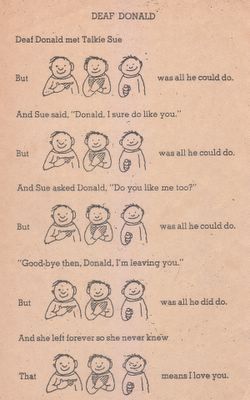
I was reminded this weekend of a poem by Shel Silverstein, from the book A Light in the Attic, about communication differences.

Deaf Donald by Shel Silverstein

Here's the text if it's a little hard to read in the image:

Deaf Donald

Deaf Donald met Talkie Sue
But [signed: I Love You] was all he could do.
And Sue said, "Donald, I sure do like you."
But [signed: I Love You] was all he could do.
And Sue asked Donald, "Do you like me too?"
But [signed: I Love You] was all he could do.
"Good-bye then, Donald, I’m leaving you."
But [signed: I Love You] was all he did do.
And she left forever and she never knew
That [signed: I Love You] means I love you.

Talkie Sue may have been a talker, but she surely wasn't much of a listener.

After reading the latest from Rhemashope over at Autism in a Word (more on that later), I found myself trying to remember:

Did Joy ever say or echo anything resembling "I love you"?

It doesn't seem like something that one could possibly forget. But it's been SO long since we've heard those 80-some words that she used to speak, once upon a time. Among all the people who are working with her now, only Lynda at daycare and one of her school-district people have known her long enough to remember hearing her use words. Right now she has no spoken words at all, communicating via her photo cards when we ask her to, or her push-button when it's available, or the occasional "more" sign, but mostly just actions and glances and gestures.

I asked JoyDad, and he set me straight right away. "No, she never did." He had worked more deliberately than I to try to get an echo of "Love you!" back when there were more words floating about, and it just never came.

But here's what she DOES do:

Hug from Joy

When he goes to pick her up at daycare, she comes running up to him and gives him a great big hug, and sometimes even gives him a little pat-pat-pat on the back.

She gives kisses upon request, and sometimes initiates little puckery kissie-kissie motions.

And remember the Popeye Sighting?

It's no wonder I got confused about how I heard, or didn't hear, the "I love you" a year and a half ago or more. I've been hearing it a lot lately, listening with all my heart. It just hasn't been verbal.

Rhemashope didn't need to hear the words spoken either, but I'm surely rejoicing with her about what happened the other night at bedtime.

Someday. Someday.

Wednesday, February 11, 2009

Icky Bicky Soda Cracker

We actually got the snow cleared off the deck over the weekend as the weather warmed up, and un-earthed (de-iced?) Rose's jumprope. Such fun to do springtime activities again! I was dredging my memories for counting rhymes for her, and came up with this one:
My mother, your mother, live across the way
Every night they have a fight and this is what they say:
Icky bicky soda cracker
Icky bicky boo
Icky bicky soda cracker
Out goes you!

Maybe "icky bicky" is what Joy has been trying to say lately...

In the past couple of weeks, Joy has been fine-tuning a two-syllable utterance. It sounds something like this:
  • ICK-ee

  • EYE-go

  • ACK-er

  • UGH-go

Now, one of the precepts of the Hanen & Communicating Partners training that I wrote about earlier is that you honor your child's vocalizations. Even if you don't know for sure what the intent is (or if there's any intent at all), if you encourage the vocalizations and treat them as legitimate communicative turn-taking, you encourage the patterns of social interaction and the idea that "when I say THIS sound, they think I mean THIS!"

So if there's anything at all that fits the sound, that'll be how we interpret it. Or if there's nothing in context that fits, we'll just imitate or play with noises. Anything to take a communicative turn.

You would be amazed at how many things the ICK-ee/EYE-go/ACK-er noise can mean.

Buckle! This one actually feels legit, in context of Joy buckling herself into her booster chair at food time.

Cracker! Speaking of food... again, we've had some really neat exchanges where it absolutely does sound like cracker.

Tickle! I heard her going back and forth with "tickle" with one of her baristas yesterday. Sure sounded real.

Thank-you! Does she know what this means? It's definitely felt like she's imitating it...

Got it! She used to have this phrase in a solid, stand-alone way, back when she had 80-some words.

Hot dog!
Echo!
Doggy!
Icky!
I go!
Blanket!
All-gone!
Icky? Bicky? Soda Cracker?


An incredibly useful utterance, wouldn't you agree?

Meanwhile, there are a few other vocalizations in the mix. Yesterday the "tickle" barista also got Joy to imitate "b-b-b" and "p-p-p" sounds. We're also getting "go" for go and "guh" for hug from time to time. Yesterday she started saying "no-no-no" just moments before attempting to climb onto the table on the deck, something she knows is a "no-no"!

We'll keep tracking this talking stuff. It's in there somewhere.

Meanwhile, when I told Rose the "icky bicky" counting rhyme, she giggled and then asked what the mothers were fighting about. I told her I had no idea, but later it occurred to me...
Maybe they're on opposing sides in the various autism controversies...

My mother, your mother, live across the way
Every night they have a fight and this is what they say:
Icky bicky DAN! doctor
Neurodiversity too
Icky bicky Andrew Wakefield
Out goes you!

Monday, January 5, 2009

Like the Coo of a Dove

And the Grinch grabbed the tree, and he started to shove,
when he heard a small sound like the coo of a dove.
He turned around fast, and he saw a small Who!
Little Cindy-Lou Who, who was not more than two.

Joy has been making the sweetest little sounds lately. Lots of little dove-coos, single syllables on falling intonations:

Awww!
Oooo.
Gohhhh.
Gooooo!
Mmmmmm.


She'll say them to herself in her crib, or at meals, or to whatever toy she's carrying around -- dolls with yarn-hair or her new My Little Pony with its lovely stimmy mane. She's also been very snuggly, and the coos are simply divine when they accompany hugs and cuddles.

GrandmaJoy and GrandpaJ (he went for the conservative alias, though really he's quite a progressive guy!) have been beneficiaries of our little Who-daughter's cooing and cuddling. They've been struck by the many changes in Joy since their last visit half a year ago. That visit was fraught with seizures and fusses and Joy outrunning them down the hall at church. This time around, Joy has been cheerful and less distractible and has done a much better job of honoring boundaries. We can even leave the bathroom doors open to air out, unthinkable half a year ago!

Alas, the grandparents are leaving this morning, and we need to get back to the regular routine. Back to daycare, and school, and work, and early rising. We'll probably get all Grinchly and shove the tree back in its box sometime in the next couple of days, all shorn of its decorations. We hope that little Cindy-Lou Who will not be disillusioned. If she starts singing Wa-hoo-dor-ay, we'll be sure to let you know.

========

I was mulling this post during the day yesterday, and was surprised at church in the evening after I'd dropped Joy off in the nursery, when one of my friends caught me in the hall and brought up the Grinch. "You know little Cindy Lou Who?" she said. I nodded, my head full of Joy. Well, she was thinking of one of my daughters, all right. But she made the comparison to Rose! I guess the sisters have more in common than I realize sometimes.

========

Update: This morning Joy's special-educator from the school district worked with Joy and heard the coo-ing. Without having read the blog, she quoted the line "like the coo of a dove" and compared Joy to Cindy-Lou Who too! I think it's becoming unanimous.

Sunday, November 23, 2008

Elvis Says "No!"

Interesting language use this week with Joy.

We are still not really hearing words on a consistent basis, though there's been a fair amount of vocalizing. Our "Popeye Sighting" (when she used the word "ug-ug-ug" for "hug" a while back) has remained in the Elvis Sighting category -- I've only heard it once since. There are a few other words that come and go:

-- "gog-gog-gog" for doggie
-- "chuh" for chair (her mealtime booster-seat)
-- a few sounds from the farm See-n-Say, her current favorite toy
-- one blessed Elvis-Sighting string of "ma-ma-ma"

The most interesting recent Elvis Sighting to me, though, is her use of the word "no." She's been doing some deliberate "nuh-nuh-nuh" to mean no, but there have also been just a couple very clear, distinct, definitive "NO" utterances.

Here's the interesting bit -- unless I'm mistaken, they've all been said to just one of her 5 intensive-autism therapists (who reads this blog faithfully, so, hi!) Not to me, or her sister, or Lynda at daycare, or JoyDad, or her school district therapists. The context tends to be when this particular therapist asks Joy to give her something that she doesn't want to give. Joy has, on just a few occasions, pulled the item away and said no, clear as a bell.

Fascinating!

She's also been responding better to "no" or "stop" from adults in a certain stimming situation she's been very persistent about. Which would be... umm, how to say this... oh well... humping. Pillows, stuffed animals, her blankets. She can get very... intense about it. Such a little sensory-seeker, our girl! It's not exactly that it's a problem, but it's the primary activity that keeps her awake when she oughtta be sleeping, and also pulls her into her own little world when she could be doing more useful, or interactive, or socially-acceptable things. So when she's not alone in her crib, we've been working on getting her to replace it with other activities.

It reminds us a little bit of another sensory activity that she was once very persistent with, which involved playing balance-beam with our low picture-window frame in the living room. There's just enough of a ledge, about a foot off the ground, for her to teeter on... and she went through a long phase of absolutely loving to teeter. Unfortunately she often teetered too far, and picked up lots of sad little bumps and bruises!

JoyDad's been the leader in these situations. I'm too much a softie, tending to think along the lines of "well, if that's the input she needs, I hate to get in the way." But JoyDad doesn't give up so easily. And, with repeated gentle admonitions (together with physical redirecting if need be), he eventually gets Joy to respond to a "No" or "Stop" voice-prompt. It eventually worked on the ledge-teetering issue -- I'm sure that he's the main reason the dimmer switch eventually slid to "off" and she stopped doing it altogether. With the "Joy loves her stuffed animals" situation, she is now willing to stop on voice-prompt. First she only accepted it from him, now she'll respond to the "no" from me (and I think from Lynda too) in that situation as well.

Yay, JoyDad!

Sunday, October 26, 2008

Popeye Sighting!

I mentioned a couple of posts ago that Joy's words have faded away in recent weeks. She's interactive, she plays peek and chase, she's experimenting with a range of vocalizations, lots of good stuff, but the words just haven't been coming out.

So it was extra-special last night to have a verbal Elvis Sighting.

I was thinning the last of the strawberry bed before the hard freeze that's supposed to hit in the next day or two. Joy was running around the back yard entertaining herself with minimal supervision.

Then she suddenly ran up to me, threw her arms around me, and said,
UGGG-ug-ug-ug-ug!

Never heard it before. Sounded for all the world like the laugh of:

Popeye the Sailor Man
Bless you, little one. I'll give you a hug-hug-hug any time you like.

Saturday, September 13, 2008

Regression Analysis

Regression. Possibly THE most frustrating aspect of Joy's development, for me anyway.

For those not living in autism-land themselves, it might surprise you to learn that big regressions are not necessarily a part of the autism trajectory. The most highly-publicized autism stories (especially in the "what causes autism" controversy accounts) often involve a great big regression at some point in the first two years of life. The child retreats into him- or herself, becomes withdrawn, loses language, almost seems like a different person -- and when the stunned parents go looking for a diagnosis, autism is what they discover.

While this is definitely one piece of the autism story, it is by no means what everyone experiences. Some kids with autism don't regress at all, others plateau, others show symptoms from the beginning and then regress, others have multiple regressions over time. There's a nice round-up of several studies on autism-related regression in a June 2008 IAN Research Report (the Interactive Autism Network, sponsored by Autism Speaks). One of the studies they cite found 46% of their sample of kids on the autism spectrum had experienced regression, but only 30% of those reported normal development up to that point. Another study with a stricter definition of regression found regression in their sample in only 11.8% of children with autism and 5.5% of children elsewhere on the autism spectrum.

Joy's in the "early symptoms" and "multiple regressions over time" categories.

I blogged in July about the "early symptoms" (When Did You First Notice...?) We definitely had a whole cascade of symptoms before we hit a regression, from language problems to interaction deficits to sensory issues, with whipped cream and seizures on top.

The first regression was subtle enough that we didn't catch it in progress. Sometime in late fall of 2006, at the age of 2 1/2, Joy started losing words and started ramping up with behavior issues. The timing was probably pretty good, if you can say such a thing, because we'd been waiting for an appointment with a prominent developmentalist who specialized in autism, and the appointment was Dec. 21. That's when we got the autism diagnosis, and the doctor pointed out autism issues left and right. She chastised me for having filled out forms describing Joy in far too glowing terms, and told me that I'd better mend my ways when applying for intensive autism therapy, because you have to paint the bleakest version of truth to have the best chance of getting the therapies you need.

And let me digress here to say what a soul-killing reality this is, on an annual basis or more, for parents of kids with special needs. At least every year for the school district, and sometimes more often than that, we have to focus on what our children can't do, in order to advocate for them and get them the best services we can. How screwed up is that?!

Anyway. The doctor also chastized our Birth-to-Three representative, who was so kind as to accompany us to the appointment, for not recognizing the autism. We all felt rather wrung-out by the end of the appointment. Merry Christmas 2006 to all!

What we hadn't yet put together was that Joy's first big regression had been happening between the time I filled out those forms and the time she got the diagnosis. The most obvious piece of the regression was that she went from about 80 words to about 20. Even that, though, can be hard to track. Think about it -- if you're even keeping track of your kiddo's words for the baby book, you write them down when you start hearing them, and then you consider them mastered. What you don't anticipate is that any utterance of that word might be the last time you hear it for goodness-knows-how-long. When do you realize that you haven't heard that word for a while? In a week? In a month?

Our tracking system got much better when we started a private Yahoo! group for Joy and started trading daily updates with Lynda the daycare lady, wherein I also began describing the Birth-to-Three therapy sessions. In this way we were able to track how Joy came out of the regression over the course of the summer. Then in the fall she started with the school district and those therapists started contributing reports of every session to our lovely online archive, documenting some very nice progress. We were back up over 80 words, starting to do some color matching, stringing chunky beads, beginning to stack Legos....

And then came Christmas 2007. This time we saw it right away, though it probably was only a little more extreme than the first time. It happened over Christmas break. Joy started losing words again, wouldn't tolerate being in the Sunday school classroom, had a behavioral down-spiral. In February 2008 we think she had a virus that made things even worse.

Good things have happened since then, for sure. Joy has begun to lead people by the hand to what she wants. We've established some nice new helper routines. Some words have come back (like ma-ma-ma-ma-ma!) She re-entered the Sunday school classroom in June. She has begun to initiate peek-a-boo games. Much to be happy about!

On the other hand, we haven't seen the level of language recovery that we did the prior summer. And Christmas is coming again in three months...

That's the worst of it, I think. Christmas is coming again, or we may see a regression sooner, or maybe later, or maybe never again. And we never know, from day to day, whether this day will be the last day that she says ma-ma-ma for the next year. We can't take any gain for granted. And that's very, very hard.

The IAN report I linked to earlier was also reporting on its own data collection about regression. Very unscientific, not peer-reviewed, self-selected respondents, self-reported information. However, despite all those caveats, there was this fascinating chart, with the big question on the chart in red:
IAN Research Report June 2008: Line Graph showing age at time of skill loss

In other words, maybe someone will start taking notice of late regressions, or multiple regressions? Maybe there's some fodder here for future research, instead of focusing autistic-regression research solely on those big initial regressions, which, devastating as they are, by no means tell the whole regression story.

Thursday, August 21, 2008

A Discouraging Word

The official song of the state where I was born has a refrain that goes like this:

Home, home on the range
Where the deer and the antelope play
Where seldom is heard a discouraging word
And the skies are not cloudy all day!

A cowboy's earthly paradise! It'd be enough to make ya want to move back, if it weren't for the fact that really Kansas has about as many discouraging words as anywhere else. And, alas, the movie Tropic Thunder is playing in Kansas as well.

There's been a lot of editorial page ink and blogospheric bytes spilled over the protests from the special-needs community about the movie's use of the "R-word": retard. As I understand it, the context is an actor (played by Ben Stiller) playing a character with cognitive disabilities, and overplaying the "simple" factor of his "Simple Jack" for Oscar-pursuit purposes. The word "retard" is bandied about indiscriminately, leading to real-world concerns -- shared by me -- that one of the movie's ugly taglines may be heard on a lot of playgrounds this fall. I won't repeat it, but you can read about it if you care to.

I won't be seeing this movie, and wouldn't anyway because a) I see something like one theatre-movie per year if I'm lucky, and b) I don't "do" trash-mouth movies that pull their big laugh-lines out of the gutter, and I'm not just talking about the "R"-word anymore.

Instead, over the past several months I've been reading my way through a clever and highly entertaining science fiction series by Lois McMaster Bujold, featuring lead character Miles Vorkosigan. Miles is a nobleman on his home planet, in the line of succession to the emperorship. He is blindingly intelligent, a man of conscience, full of manic energy, apparently arrogant but battling inner bogeymen. He commands a fleet of space mercenaries, and has adventures, romantic and otherwise, all around the galaxy.

He's also just over four feet tall, with startlingly brittle bones and other physical frailties, the in-utero victim of a chemical attack on his mother before he was born. His home planet has a low tolerance for physical difference, to put it mildly. The "R-word" that gets used against Miles is "mutie," short for mutant.

Joy and I have not yet heard our own planet's discouraging epithets used against her. With any luck, we'll avoid it for some years longer. I'm not so naive, though, as to think that it isn't going to happen at some point.

Meanwhile, I shield myself against the day, rejoicing in Joy's accomplishments and entertaining myself with the successes of Miles Vorkosigan. Who needs the movies, anyway?